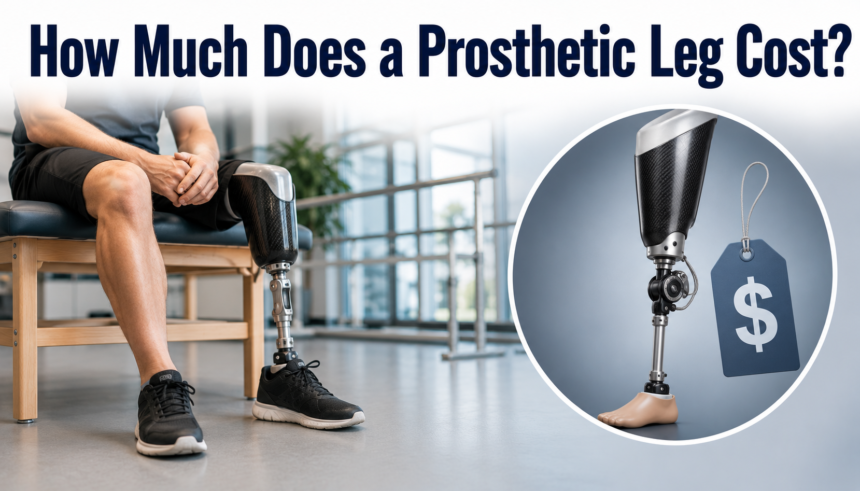
If you or someone close to you is exploring limb replacement options, the first question that usually comes to mind is how much does a prosthetic leg cost. The honest answer is that there is no single fixed price, because the final amount depends on the type of device, the materials used, the level of technology built into it, and where you live.
On average, people pay anywhere between $5,000 for a basic mechanical leg and $100,000 or more for an advanced microprocessor-controlled limb. Below, this guide breaks every part of that pricing puzzle into simple, easy-to-understand sections so you can plan your budget with confidence.
Types of Prosthetic Legs
Before looking at numbers, it helps to understand that not all prosthetic legs are built the same way. The type of amputation and the level of mobility a person needs directly shapes which device category applies to them.
Below-Knee (Transtibial) Prosthetic
A below-knee prosthetic is designed for people who have lost their leg beneath the knee joint, meaning the natural knee is preserved. Because the knee still functions naturally, this type of device is generally simpler to build and fit compared to other options. It usually costs less than above-knee models since it requires fewer mechanical parts to replicate movement.
Above-Knee (Transfemoral) Prosthetic
An above-knee prosthetic replaces the leg from above the knee joint, which means it must include an artificial knee mechanism along with the foot and socket. This added complexity increases both the engineering effort and the final price tag. These devices demand more advanced components to help the user walk, balance, and climb stairs safely.
Hip Disarticulation Prosthetic
A hip disarticulation prosthetic is used when the amputation occurs at or near the hip joint, removing the entire leg. This is the most complex prosthetic category because it must recreate hip, knee, and ankle movement together. As a result, these devices tend to sit at the higher end of the price spectrum due to their intricate design requirements.
Cost by Prosthetic Type
Pricing also depends heavily on the technology level inside the limb, not just where the amputation occurred. Broadly speaking, prosthetic legs fall into mechanical and computerized categories.
Basic Mechanical Prosthetics
Basic mechanical prosthetic legs rely on simple hinges, springs, and manual locking systems rather than electronics. They are lighter on the wallet, typically ranging from $5,000 to $15,000, making them a practical starting point for many first-time users. While they lack advanced adaptive features, they remain durable and reliable for everyday walking.
Microprocessor-Controlled Prosthetics
Microprocessor-controlled prosthetics use built-in sensors and small computers to adjust movement in real time, responding to walking speed, terrain, and incline. This smart technology allows for a much more natural gait, but it comes at a steep price, often between $20,000 and $100,000 or more. These are usually recommended for highly active users or those who need extra stability.
Price Breakdown by Component
A prosthetic leg is not a single object but an assembly of several individual parts, and each one carries its own separate cost. Understanding this breakdown helps explain why total prices can swing so widely.
| Component | Function | Typical Price Range |
| Socket | Connects the residual limb to the device | $2,000 – $8,000 |
| Pylon | The structural support tube of the leg | $500 – $2,000 |
| Prosthetic Foot | Absorbs shock and mimics natural foot movement | $1,000 – $10,000 |
| Knee Joint (if applicable) | Enables bending and walking control | $3,000 – $50,000 |
| Suspension System | Keeps the prosthetic securely attached | $500 – $3,000 |
Factors That Affect Price
Several variables combine to determine the final bill a patient receives, and no two cases look exactly alike. Material choice plays a major role, since carbon fiber components are lighter and more expensive than standard plastics or basic metals.
The technology level matters too, as bionic or robotic features push prices far higher than purely mechanical designs. Custom fitting is another factor, because a socket molded precisely to an individual’s limb shape takes more clinical time and skill than a generic fit.
Finally, a patient’s activity level influences the choice of components, since athletes or physically active individuals often require sturdier, higher-performance parts than someone who mainly needs the limb for light daily movement.
Average Cost Ranges
To make budgeting easier, here is a general summary of what most patients can expect to pay across different quality tiers.
| Tier | Price Range | Best Suited For |
| Low-End | $5,000 – $10,000 | Basic daily mobility needs |
| Mid-Range | $10,000 – $30,000 | Moderate activity and comfort features |
| High-End / Bionic | $30,000 – $100,000+ | Athletes, active adults, advanced mobility needs |
Insurance Coverage
Private health insurance in many countries offers partial coverage for prosthetic limbs, though the exact percentage depends heavily on the specific policy a person holds. Some plans cover a large share of the device cost but limit how often a replacement can be approved, sometimes allowing only one new limb every three to five years.
Other policies exclude advanced microprocessor components entirely, treating them as elective upgrades rather than medical necessities. Because of this variation, it is worth reviewing your policy documents closely or speaking directly with your insurance provider before committing to a specific prosthetic model.
Medicare & Medicaid Coverage
In the United States, Medicare typically classifies prosthetic legs as durable medical equipment and covers around 80 percent of the approved cost once the annual deductible is met.
Medicaid coverage varies by state, and eligibility rules, replacement timelines, and approved component lists can differ significantly depending on where a patient lives.
Patients relying on either program should confirm current coverage limits with their local office, since policies are updated periodically and older cost estimates may no longer apply.
Costs by Country
Prosthetic leg pricing is not uniform worldwide, and healthcare systems play a large role in what patients actually pay out of pocket.
| Country | General Cost Situation |
| United States | High retail prices, partial insurance or Medicare support |
| United Kingdom | Often free or low-cost through the NHS |
| Canada | Partial public coverage, varies by province |
| Australia | Subsidized through public healthcare schemes |
| Developing Countries | Lower base costs, but limited access to advanced technology |
Hidden & Additional Costs
Beyond the price of the prosthetic leg itself, patients should budget for several recurring expenses that are easy to overlook at first. These typically include the following:
- Initial fitting and adjustment appointments with a certified prosthetist
- Physical therapy sessions to learn proper gait and balance
- Routine maintenance checks to keep mechanical parts functioning smoothly
- Replacement liners and sleeves, which wear out faster than the main device
- Socket adjustments needed as the residual limb changes shape over time
Lifetime Cost of Ownership
A prosthetic leg is rarely a one-time purchase, since most devices need replacement every three to five years due to wear, growth changes, or evolving mobility needs.
Over a lifetime, this replacement cycle can add up to a substantial total investment, especially for younger patients who will need multiple upgrades as their bodies change.
Planning for this long-term expense early, rather than focusing only on the initial purchase price, gives patients and families a much more realistic financial picture.
Financial Assistance Options
Fortunately, the full cost rarely has to be paid entirely out of pocket, since several support avenues exist for eligible patients. Common options include:
- Nonprofit organizations that provide grants or subsidized devices
- Veteran benefit programs for former service members
- Crowdfunding campaigns to cover gaps left by insurance
- Manufacturer or clinic payment plans that spread costs over several months
How to Reduce Costs?
Patients looking to manage expenses without sacrificing essential function have a few practical strategies available. Choosing a refurbished or previously used device through a certified provider can lower costs significantly while still meeting safety standards.
Comparing quotes and negotiating directly with prosthetic clinics sometimes reveals pricing flexibility that is not advertised upfront. Selecting a technology tier that matches actual daily needs, rather than the most advanced model available, also prevents overspending on features that may not be necessary for every lifestyle.
Choosing the Right Prosthetic for Your Budget
The best prosthetic leg is not always the most expensive one, but rather the device that matches an individual’s activity level, comfort needs, and long-term budget realistically.
A retiree with light mobility needs may do perfectly well with a mid-range mechanical option, while a competitive athlete might justify the higher cost of a microprocessor-controlled limb.
Working closely with a certified prosthetist to weigh these trade-offs ensures the final choice supports both daily comfort and financial sustainability.
Conclusion
So, how much does a prosthetic leg cost in the end? The realistic range spans from around $5,000 for a basic mechanical model to well over $100,000 for a top-tier bionic limb, with insurance, government programs, and financial assistance often covering part of the bill.
Understanding component pricing, hidden expenses, and long-term replacement costs helps patients make informed, confident decisions rather than being caught off guard by unexpected fees.
FAQs
Does insurance cover a new prosthetic leg every year? No, most insurance plans and Medicare typically approve replacements every three to five years rather than annually, unless a medical change makes an earlier replacement necessary.
Why do microprocessor knees cost so much more than mechanical ones? Microprocessor knees contain sensors, batteries, and computer chips that adjust movement automatically, and this added engineering complexity significantly raises manufacturing and fitting costs.
Can Medicaid patients get advanced prosthetic technology? Coverage varies by state, and while some Medicaid programs approve advanced components, others limit funding to basic or mid-range devices depending on medical necessity documentation.
Is a below-knee prosthetic always cheaper than an above-knee one? Generally yes, since below-knee devices preserve the natural knee joint and require fewer mechanical parts, though exact pricing still depends on materials and technology chosen.
RELATED ARTICLES
Do Pimple Patches Work on Blackheads? Here’s the Truth
Surgical Elevation of Depressed Skull Fracture: Complete Treatment Guide
How Long Does Pink Eye Bacteria Stay on Surfaces?
When Do Pregnancy Cravings Start? Complete Timeline & Causes Guide
Can Kidney Stones Cause Lower Back Pain? Causes, Symptoms & Relief