


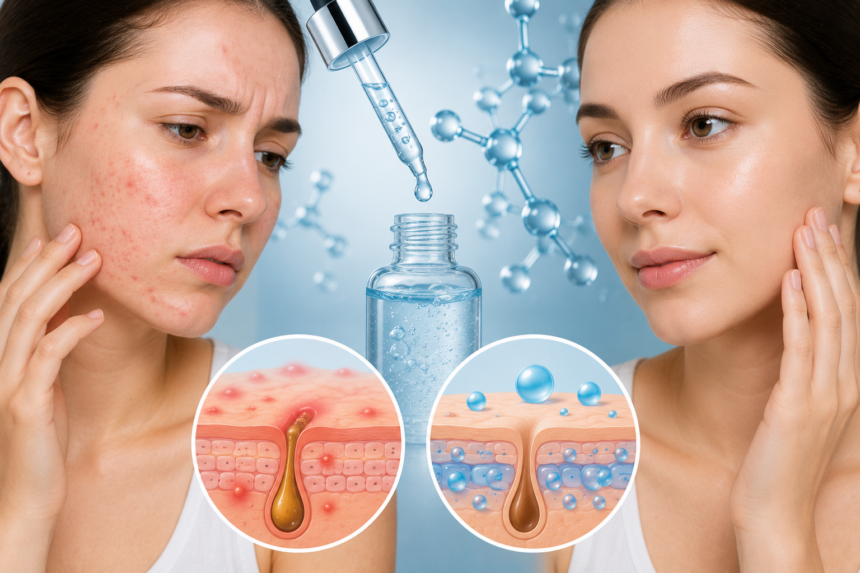
Can hyaluronic acid cause acne, or is something else in your serum to blame? If you’ve broken out after adding a new hydrating product, it’s natural to suspect the ingredient everyone’s talking about. This guide breaks down what hyaluronic acid actually does to your skin, why breakouts sometimes follow, and how to use it safely if you’re acne-prone.
You’ll get a clear, dermatologist-informed answer, plus practical steps to tell the difference between a real reaction and normal purging.
Key Takeaways
- Hyaluronic acid has a comedogenic rating of 0 out of 5, meaning it doesn’t clog pores on its own.
- Breakouts after starting an HA serum are usually caused by other ingredients — oils, fragrance, or alcohol denat — not the HA molecule itself.
- Dehydrated skin can overproduce oil, so skipping hydration often backfires for acne-prone skin.
- Low molecular weight HA penetrates deeper and may irritate compromised skin barriers; high molecular weight HA sits on the surface.
- Purging from actives like retinoids typically clears within 4–6 weeks; a true reaction to a formula usually doesn’t.
- A fragrance-free, oil-free, gel-based HA serum is the safest starting point for breakout-prone skin.
Does Hyaluronic Acid Cause Acne?
Hyaluronic acid does not cause acne. It’s a humectant your skin already produces, and it carries a comedogenicity rating of 0 out of 5 on the scale dermatologists use to grade pore-clogging potential, based on a framework refined in a 2006 Journal of the American Academy of Dermatology re-evaluation of comedogenicity testing.
Dermatologist Dr. Joshua Zeichner of Mount Sinai Hospital has described hyaluronic acid simply as a sugar molecule that occurs naturally in skin and is generally well tolerated across skin types, including oily and breakout-prone complexions. The American Academy of Dermatology (AAD) also lists it among ingredients considered appropriate for acne-prone skin.
Warning: “Non-comedogenic” describes the HA molecule itself, not every product labeled with it. Full formulas can still contain pore-clogging additives, so the ingredient list matters as much as the headline claim.
Why Am I Breaking Out After Using Hyaluronic Acid?
If HA doesn’t clog pores, why do breakouts sometimes follow? The answer almost always sits elsewhere in the bottle or in how the skin is reacting to change.
The Formula Is the Usual Culprit
Hyaluronic acid serums rarely contain HA alone. Preservatives, emulsifiers, silicones, and fragrance all touch the skin at the same time, and any of them can trigger a breakout in sensitive or acne-prone users.
- Comedogenic carrier oils: Coconut oil, for example, rates 4 out of 5 on the comedogenic scale and is a common filler in budget serums.
- Synthetic fragrance: One of the most frequent causes of contact irritation and flare-ups in reactive skin.
- Alcohol denat: Strips the skin barrier and can push oil glands into overdrive.
Pro Tip: Scan the first ten ingredients on the label. If HA is buried under oils or fragrance compounds, the serum isn’t a “clean” HA formula — it’s a multi-active product wearing an HA label.
Purging vs. a True Reaction
Purging happens when an active ingredient — usually a retinoid, AHA, or BHA layered alongside HA — speeds up cell turnover and pushes existing congestion to the surface faster than normal.
| Feature | Purging | True Reaction |
| Timing | Starts within first 2 weeks | Can appear anytime |
| Location | Areas you normally break out | New, unfamiliar areas |
| Duration | Resolves in 4–6 weeks | Persists beyond 4 weeks |
| Appearance | Small, similar-looking whiteheads | Redness, itching, closed comedones |
If breakouts fall into the “true reaction” column, the fix is usually simplifying the formula, not abandoning hyaluronic acid altogether.
Is Hyaluronic Acid Comedogenic? What the Science Says
Comedogenicity testing dates back decades, but the modern reference point most dermatologists cite is the 2006 re-evaluation published in the Journal of the American Academy of Dermatology, which scored ingredients from 0 (non-comedogenic) to 5 (highly comedogenic). Hyaluronic acid scores a 0.
This holds true across both major forms of the molecule:
- Low molecular weight HA (under 50 kDa): Penetrates deeper into skin, which can occasionally trigger mild inflammation on compromised or highly reactive barriers.
- High molecular weight HA (over 1,000 kDa): Stays on the surface, hydrates the outer layer, and carries a lower irritation risk.
Neither form has demonstrated pore-clogging behavior in comedogenicity testing, which is why the “hyaluronic acid comedogenic” search remains largely a myth rooted in formula confusion rather than the molecule itself.
Hypothetical Example (for illustration purposes): A 24-year-old with oily, acne-prone skin switches from a heavy night cream to a fragrance-free, gel-based hyaluronic acid serum. Within two weeks, she notices fewer new blemishes and less midday shine, likely because her skin no longer needs to overcompensate for dryness with extra oil production. Note: This scenario is illustrative. Actual results vary by skin type, formulation, and overall routine.
Can Hyaluronic Acid Actually Help Acne-Prone Skin?
Used correctly, hyaluronic acid can support — not sabotage — an acne routine. Dermatologist Dr. Sandra Lee (“Dr. Pimple Popper”) has explained that when skin senses dehydration, it can respond by signaling the sebaceous glands to produce more oil, which contributes to clogged pores and new breakouts.
That cycle matters for anyone using drying acne treatments like benzoyl peroxide, retinoids, or salicylic acid:
- Hyaluronic acid replaces lost moisture without adding oil to the skin’s surface.
- A properly hydrated barrier is better equipped to resist irritation from active acne treatments.
- Reduced dryness can lower the compensatory oil production that feeds breakouts.
Pro Tip: Apply hyaluronic acid to slightly damp skin right after cleansing, then follow with your acne treatment. HA works by drawing in moisture, so damp skin gives it more to hold onto than dry skin does.
Comparing Hyaluronic Acid Formulations for Acne-Prone Skin
Not every HA product suits breakout-prone skin the same way. Here’s how the main formulation types stack up.
| Formulation Type | Best For | Comedogenic Risk | Texture | Watch-Outs |
| Fragrance-free gel serum | Oily, acne-prone skin | Very low | Lightweight, fast-absorbing | Check for hidden alcohol denat |
| Cream-based HA moisturizer | Dry, non-reactive skin | Low–moderate | Richer, slower absorption | Often blended with occlusive oils |
| Low molecular weight HA | Deeper hydration needs | Low | Thin, penetrates fast | Can irritate compromised barriers |
| High molecular weight HA | Surface hydration, sensitive skin | Very low | Slight film on skin | May feel tacky if overused |
| Multi-active HA + retinol | Anti-aging + acne combo routines | Moderate (from retinol, not HA) | Varies | Expect purging in first 2–6 weeks |
How to Choose the Right Hyaluronic Acid for Acne-Prone Skin?
Selecting a safe formula comes down to reading past the marketing and checking the ingredient list itself.
- Look for “non-comedogenic” and “oil-free” on the label — these terms filter out the most common breakout triggers.
- Choose a gel or water-light serum over creams if your skin is oily or combination.
- Check for fragrance — even “natural fragrance” can irritate reactive skin.
- Confirm a neutral pH, ideally between 5.0 and 7.0, which supports the skin barrier.
- Patch test on your jawline for two weeks before applying to your full face.
Warning: If you have a diagnosed allergy to hyaluronic acid or have had a reaction to HA-based dermal fillers, speak with a dermatologist before trying topical HA products — this reaction is rare but should be medically evaluated.
Ingredients to Watch for in Hyaluronic Acid Products
Since the HA molecule itself is off the hook, the real work is learning to spot the ingredients that ride along with it. Acne-prone skin reacts most often to a small, repeatable list of additives.
- Isopropyl myristate and isopropyl palmitate: Common texture-enhancers that rank moderately high on the comedogenic scale.
- Cocoa butter and coconut oil: Rich emollients that feel luxurious but can trap sebum in oily skin.
- Denatured alcohol: Listed as “alcohol denat” or “SD alcohol,” it dries the surface while triggering rebound oil production underneath.
- Synthetic fragrance or parfum: A leading cause of contact irritation, especially on already-inflamed acne lesions.
Pro Tip: If a product’s ingredient list runs longer than 15–20 items, it’s harder to pinpoint what’s actually causing a reaction. Shorter formulas make troubleshooting far easier.
When to See a Dermatologist?
Most breakouts linked to hyaluronic acid resolve once the formula is simplified. But some situations call for professional input:
- Breakouts persist beyond 4–6 weeks despite switching to a cleaner formula.
- New bumps appear alongside redness, itching, or swelling.
- You’re managing cystic acne, which forms deep beneath the surface and needs medical treatment such as prescription retinoids, oral antibiotics, or hormonal therapy — hyaluronic acid can support hydration during treatment but won’t resolve cystic lesions on its own.
Frequently Asked Questions
Q: Does hyaluronic acid clog pores?
No. Hyaluronic acid carries a comedogenicity rating of 0 out of 5, meaning it does not clog pores. Breakouts linked to HA products usually come from other ingredients in the formula.
Q: Can hyaluronic acid make acne worse?
Rarely, and usually indirectly. It can worsen breakouts if paired with heavy oils, occlusive layers, or fragrance in the same product, or if applied in dry air where it pulls moisture from the skin instead of the environment.
Q: Is hyaluronic acid good for acne-prone skin?
Yes. It hydrates without adding oil, helps offset dryness from acne treatments, and supports barrier repair, which can reduce compensatory oil production that contributes to breakouts.
Q: Why did I break out after using hyaluronic acid serum?
The most likely causes are a reaction to another ingredient in the formula, purging from a paired active like retinol, or layering HA under a heavy, comedogenic moisturizer.
Q: Can you use hyaluronic acid with salicylic acid?
Yes. HA pairs well with salicylic acid, offsetting its drying effect. Apply water-based actives like salicylic acid first, then layer hyaluronic acid, then seal with moisturizer.
Q: Is hyaluronic acid comedogenic?
No. Testing places hyaluronic acid at 0 on the 0–5 comedogenicity scale, for both low and high molecular weight forms.
Q: How long does hyaluronic acid purging last?
True HA-related purging is uncommon since HA doesn’t speed up cell turnover. If purging occurs, it’s usually from a paired active like a retinoid or BHA, and typically resolves in 4–6 weeks.
Final Thoughts
Hyaluronic acid isn’t the villain behind most breakouts — it’s non-comedogenic, hydrating, and genuinely useful for skin already dealing with acne.
When blemishes do follow a new HA serum, the real cause is almost always the formula’s other ingredients, dry-air moisture pulling, or purging from a separate active.
Choose a fragrance-free, oil-free, gel-based formula, patch test first, and hyaluronic acid can become one of the safest steps in an acne-prone routine.


