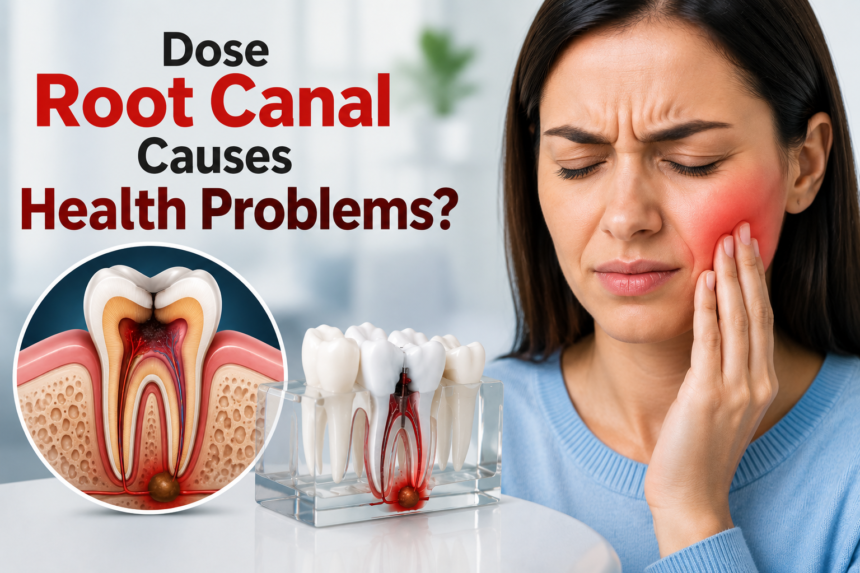
If you’ve been told you need a root canal, you’ve probably also stumbled across articles online claiming the procedure can trigger anything from chronic fatigue to cancer. So does root canal cause health problems, or is this just internet noise built on outdated theories?
The honest answer sits somewhere in between: root canals don’t cause systemic illness, but they do come with a small set of real, well-documented side effects that are worth knowing before you sit in the dentist’s chair.
Does a Root Canal Cause Health Problems?
No, a root canal does not cause illnesses elsewhere in your body. Major dental authorities, including the American Association of Endodontists and the American Dental Association, have repeatedly confirmed there’s no scientific link between root canal treatment and diseases like cancer, heart disease, or autoimmune disorders.
This reassurance matters because the claim has circulated online for decades, often presented as suppressed or overlooked information rather than what it actually is: a theory that was tested and disproven nearly a century ago. What root canals can occasionally cause are localized, mostly temporary issues such as discoloration, sinus discomfort, or nerve sensitivity near the treated tooth.
These are minor compared to the risks of leaving an infected tooth untreated, which is the actual health problem worth worrying about.
What Happens During a Root Canal?
A root canal becomes necessary when the soft tissue inside your tooth, called the pulp, gets infected or inflamed due to deep decay, repeated dental work, or a crack. During the procedure, your dentist removes this infected pulp, cleans out the narrow canals inside the tooth root, and then seals everything with a filling material.
A crown is often added afterward to protect the now-hollow tooth from cracking under normal chewing pressure. Most root canals are completed in one or two visits, and modern anesthesia means the treatment itself is generally no more uncomfortable than getting a filling, despite its reputation. The goal is simple: eliminate the infection while keeping your natural tooth in place instead of pulling it out.
The Root Canal-Illness Myth: Where It Came From
The idea that root canals cause systemic disease isn’t new, and it isn’t based on current research either. It traces back to the 1920s, when a dentist named Weston Price proposed that bacteria trapped in treated teeth could silently cause chronic illnesses throughout the body.
At the time, the medical community had limited understanding of bacterial infections, so the theory gained traction and led to a wave of unnecessary tooth extractions.
By the 1930s, better-designed studies disproved Price’s focal infection theory, and root canal treatment was gradually reestablished as a safe, standard procedure. Yet the myth never fully disappeared, and it still resurfaces in alternative health circles today.
What Science Actually Says?
Modern research simply doesn’t support the claim that root canals lead to systemic disease. Large-scale studies tracking patients who’ve had root canal treatment show no increased risk of cancer or chronic illness compared to the general population.
Dental associations point out that once the infected pulp is removed and the canal is properly sealed, the source of bacterial activity is eliminated, not preserved. The confusion often comes from older, smaller studies with weak methodology, or from cases of improperly performed root canals, which are a separate issue from the procedure itself being unsafe.
It’s also worth noting that “root canal treated tooth” and “infected, untreated tooth” are not the same thing, and much of the alarming content online blurs that distinction.
Real Root Canal Side Effects You Should Know About
While root canals don’t cause systemic disease, a few localized side effects are genuinely common and worth understanding ahead of time.
Tooth discoloration
Once the pulp is removed, the tooth can darken slightly over time since it’s no longer receiving nutrients or moisture from living tissue. This is purely cosmetic and easily corrected with a crown or veneer if it bothers you.
Sinus pressure or congestion
Upper back teeth sit close to the sinus cavities, so some patients notice mild sinus pressure, a salty taste, or light congestion for a week or two after treatment. It typically resolves on its own without intervention, though a saline rinse can help speed things along if it lingers.
Temporary numbness or tingling
In rare cases, the nerves surrounding the treated tooth can feel numb or tender for a short period. This usually fades within a few weeks as the area heals.
Increased brittleness
A root canal removes the tooth’s internal blood supply, which can make it more prone to cracking under heavy chewing. This is exactly why dentists usually recommend a crown afterward, to reinforce the tooth structurally.
Can a Root Canal Get Reinfected?
Reinfection is uncommon, but it can happen, usually due to a cracked filling, a failed seal, or bacteria that weren’t fully cleared during treatment. The canals inside a tooth root are narrow and sometimes branch off in ways that are easy to miss without specialized equipment, which is why complex cases are often referred to an endodontist rather than handled by a general dentist.
Warning signs of reinfection include persistent pain when chewing, swelling around the gum line, or a return of sensitivity to hot and cold. If any of these show up weeks or months after treatment, it’s worth getting the tooth rechecked rather than waiting it out, since reinfections rarely resolve on their own.
Root Canal vs. Tooth Extraction: Which Carries More Risk?
It’s natural to wonder whether pulling the tooth instead would simply be safer, but extraction comes with its own set of complications. Removing a tooth can lead to bone loss in the jaw over time, shifting of neighboring teeth, and the need for a bridge or implant to fill the gap, which is often more invasive and expensive than the root canal itself.
Replacing an extracted tooth can also take months of healing before an implant can even be placed, whereas a root canal restores full function almost immediately. A root canal, by comparison, preserves your natural bite and jaw structure while resolving the infection. For most patients, keeping the natural tooth through root canal treatment carries fewer long-term downsides than extraction.
What Happens if You Leave an Infected Tooth Untreated?
This is where the real health risk lies, and it has nothing to do with getting the root canal itself. An untreated tooth infection can spread from the pulp into the surrounding bone, forming a painful abscess.
Left unchecked, that infection can travel into nearby tissues in the face, jaw, or neck, and in rare but serious cases, it can enter the bloodstream and trigger sepsis, a life-threatening condition. Compared to these risks, a root canal is the far safer and more conservative choice.
Who Is More Likely to Experience Root Canal Complications?
Most people sail through root canal treatment without any lasting issues, but certain factors raise the odds of complications. Patients with weakened immune systems, uncontrolled diabetes, or a history of gum disease may heal more slowly or face a higher chance of reinfection.
Teeth with unusually curved or narrow canals can also be harder to fully clean, which slightly increases the risk of leftover bacteria. Smokers and patients who delay getting their permanent crown placed also tend to see higher rates of tooth fracture afterward. Choosing an experienced endodontist for complex cases, rather than a general dentist, significantly reduces these risks.
How to Reduce Risks Before and After Your Root Canal?
A few simple habits go a long way in keeping your root canal trouble-free. Before treatment, mention any allergies, medications, or chronic conditions to your dentist so they can plan accordingly. Afterward, avoid chewing on the treated tooth until it’s protected with a permanent crown, and stick to good oral hygiene to prevent new decay around the area.
Gentle brushing, regular flossing, and routine checkups also help your dentist catch any seal issues early, before they turn into reinfection. Skipping follow-up appointments or delaying the crown placement are two of the most common reasons root canals run into trouble later on.
When to Call Your Dentist After a Root Canal?
Mild soreness for a few days after treatment is completely normal and usually fades with over-the-counter pain relief.
However, you should call your dentist if you notice swelling that gets worse instead of better, a fever, pain that intensifies after the first week, or visible pus near the gum line.
These can be signs of reinfection or an incomplete seal, both of which are easily fixable when caught early but can lead to bigger problems if ignored.
FAQs
Can a root canal cause cancer?
No. Multiple large studies and dental health authorities have found no link between root canal treatment and cancer risk.
Why do some people still believe root canals are dangerous?
The belief largely stems from a disproven 1920s theory that infected teeth secretly caused chronic disease throughout the body, an idea modern research has since ruled out.
Is it normal to feel unwell after a root canal?
Mild discomfort or pressure for a few days is normal, but ongoing fatigue, fever, or worsening pain isn’t typical and should be checked by your dentist.
How long do root canal side effects usually last?
Most minor side effects, like sensitivity or sinus pressure, resolve within one to two weeks as the area heals.
Do I need a crown after every root canal?
Most back teeth need a crown afterward since they bear heavy chewing pressure and are more prone to fracture once the pulp is removed. Front teeth sometimes only need a filling, depending on how much structure remains.
Can a root canal cause cancer?
No. Multiple large studies and dental health authorities have found no link between root canal treatment and cancer risk.
Why do some people still believe root canals are dangerous?
The belief largely stems from a disproven 1920s theory that infected teeth secretly caused chronic disease throughout the body, an idea modern research has since ruled out.
Conclusion
So, does root canal cause health problems? Not in the way the myths suggest. The fear linking root canals to cancer or chronic illness traces back to a nearly century-old theory that’s been thoroughly disproven, and current research from leading dental authorities backs that up.
What you might actually experience is mild, temporary, and manageable: a bit of discoloration, some sinus pressure, or short-lived numbness, none of which compared to the real risk of leaving an infected tooth untreated.
If your dentist recommends a root canal, it’s a sign they’re trying to save your tooth and prevent a far more serious problem down the line, not create one. As always, keep up with your follow-up care and reach out to your dentist if anything feels off after treatment.
Related Articles
Does Cataract Cause Headaches? Causes, Symptoms, Treatment, and Prevention Guide
Headache After Wisdom Teeth Removal: Causes, Relief, Recovery, and When to Worry
Neptune Health: Services, Workplace Wellness, Telehealth, Benefits, and Future Innovations
Fungal Acne vs Bacterial Acne: Understanding the Key Differences, Symptoms, and Treatments
Can Vaping Cause Acne? Understanding the Connection Between Vaping and Breakouts