


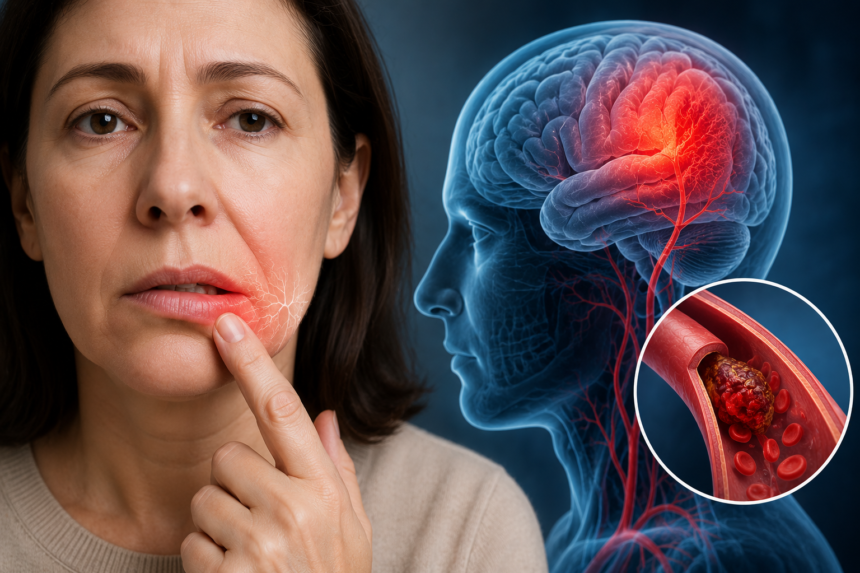
Are numb lips a sign of stroke? In most cases, isolated numbness in the lips has a simple explanation, but sudden, one-sided numbness can sometimes point to something more serious happening in the brain.
The lips receive sensation through a nerve pathway that runs from the face to specific processing centers deep inside the brain, and a disruption anywhere along that path can change how the lips feel.
This does not mean every tingling sensation around the mouth is an emergency, but it does mean the symptom deserves attention rather than dismissal. The sections below explain how to tell a stroke-related cause apart from an everyday one, and what to do next in either case.
Key Takeaways
• Numb lips can occasionally be a genuine stroke symptom, particularly when they appear suddenly and affect one side.
• FAST symptoms occurring alongside numb lips are a signal to call emergency services right away.
• Most cases of lip numbness come from migraines, anxiety, cold exposure, dental work, or nutrient deficiencies.
• A doctor’s evaluation, including imaging when needed, is the only reliable way to confirm the exact cause.
Can Numb Lips Be a Sign of Stroke?
Yes, numb lips can be a sign of stroke, though this is not the most common way a stroke presents. Sensation in the lips travels through the trigeminal nerve to a part of the brain called the thalamus, and small strokes affecting this region can produce numbness limited to the lips, chin, or tongue without any other symptom appearing.
Medical case reports have documented patients whose only stroke symptom was sudden numbness around the mouth, later confirmed through brain imaging. Because of this, doctors do not dismiss lip numbness even when it shows up on its own, especially if it began suddenly and affects only one side of the face.
Recognizing the FAST Warning Signs of Stroke
The FAST method remains the quickest way to check whether numb lips might be linked to a stroke. Each letter stands for a symptom that, when combined with facial numbness, raises the level of concern significantly.
Face Drooping
One side of the face may begin to droop or feel uneven, often alongside the numbness in the lips. Ask the person to smile and check whether both sides move equally. Uneven movement combined with numbness is a strong indicator that emergency care is needed.
Arm Weakness
Sudden weakness or heaviness in one arm frequently accompanies stroke-related facial numbness. Ask the person to raise both arms and hold them steady for a few seconds. If one arm drifts downward or cannot lift at all, this points toward a stroke rather than a minor cause.
Speech Difficulty
Slurred speech, trouble finding words, or sentences that suddenly sound garbled often appear together with numb lips during a stroke. Ask the person to repeat a simple sentence and listen closely for changes in clarity. Speech changes paired with facial numbness should never be brushed off.
Time to Call Emergency Services
If any of the symptoms above appear alongside numb lips, the correct response is to call emergency services right away rather than waiting to see if they pass. Stroke treatment works best within the first few hours after symptoms begin, so every minute matters. Note the exact time the symptoms started, since this detail helps doctors choose the right treatment.
Other Symptoms That May Accompany Numb Lips During a Stroke
Beyond the FAST symptoms, a stroke can bring on sudden confusion, difficulty understanding a simple conversation, or trouble processing what is happening nearby.
Vision changes such as blurred sight, double vision, or a sudden loss of vision in one eye can also appear alongside lip numbness.
Some people lose their balance or feel unsteady on their feet, while others experience an unusually severe headache that starts without warning.
When numb lips show up together with any of these signs, the combination points more strongly toward a stroke than lip numbness on its own ever would.
Stroke-Related vs. Non-Stroke Causes of Numb Lips
The table below compares how stroke-related lip numbness typically differs from more common, far less serious causes, making it easier to judge how urgently a case needs attention.
| Cause | Onset | Distinguishing Signs | Recommended Action |
| Stroke / TIA | Sudden | One-sided, often with facial drooping, arm weakness, or speech trouble | Call emergency services immediately |
| Migraine aura | Gradual (minutes) | Preceded or followed by headache; may include visual aura | See a doctor if new or frequent |
| Anxiety / hyperventilation | Sudden | Both sides of lips; tingling in hands or feet too | Slow breathing; monitor if recurring |
| Dental nerve irritation | After procedure | Localized to treated area; follows recent dental work | Follow up with dentist if prolonged |
| Cold exposure | Immediate | Both lips; resolves quickly on warming up | No action needed |
| B12 or calcium deficiency | Gradual | Fatigue, muscle cramps, tingling elsewhere too | Bloodwork and supplementation |
| Bell’s palsy | Hours | One-sided facial weakness without arm or speech involvement | Medical evaluation to rule out stroke |
Common Non-Stroke Causes of Numb Lips
Most cases of lip numbness have nothing to do with stroke and instead come from far more common, everyday conditions. Understanding these causes can help you judge whether the sensation truly needs urgent attention.
Migraine With Sensory Aura
Some migraines begin with an aura that includes tingling or numbness around the lips, cheek, or tongue before the headache itself starts. This sensation usually spreads gradually over several minutes rather than appearing all at once. It typically fades once the migraine episode passes and tends to repeat in a similar pattern each time it happens.
Anxiety and Hyperventilation
Breathing too quickly during a panic or anxiety episode lowers carbon dioxide levels in the blood, which can cause tingling around the mouth and in the fingertips. This type of numbness usually affects both sides of the lips rather than just one. Slowing the breathing back down often brings relief within just a few minutes.
Dental Procedures and Nerve Irritation
Numbness after a dental injection or extraction is common and usually fades within a few hours as the anesthetic wears off completely. In rare cases, irritation of a nearby nerve during the procedure can cause numbness that lingers longer. This type of numbness stays localized to the treated area and follows a recent dental visit, which makes the cause easy to identify.
Cold Exposure and Nutrient Deficiency
Cold temperatures can temporarily numb the lips by reducing blood flow near the skin’s surface, and the feeling usually returns once the area warms back up. A shortage of vitamin B12 or calcium can also cause tingling in the lips along with fatigue or muscle cramps. Both of these causes tend to build up gradually rather than appearing without warning.
Bell’s Palsy and Other Nerve Conditions
Bell’s palsy is a temporary weakness of the facial nerve that can cause numbness or a heavy feeling on one side of the face, including the lips. Unlike a stroke, it does not usually affect the arms or speech, and it tends to develop over several hours rather than instantly. A doctor can tell it apart from a stroke through a focused physical examination.
When to See a Doctor vs. When to Call Emergency Services
Numb lips that appear suddenly, affect only one side, or occur alongside any FAST symptom call for an emergency room visit or a call to emergency services without any delay.
Numbness that develops gradually, affects both sides, or follows a clear trigger such as cold weather or a recent dental visit is less urgent but still worth mentioning to a doctor if it continues or keeps coming back.
When in doubt, treating the symptom as an emergency is always the safer choice, since the cost of a false alarm is far lower than the cost of a delayed stroke diagnosis.
How Doctors Diagnose the Cause of Numb Lips?
When someone arrives with numb lips, doctors usually begin with a neurological examination that checks facial movement, strength, coordination, and speech clarity.
Brain imaging such as a CT scan or MRI can reveal whether a stroke has occurred and pinpoint its exact location within the brain.
Blood tests may be ordered to rule out vitamin deficiencies or electrolyte imbalances, and a referral to a neurologist, dentist, or ENT specialist may follow depending on what the initial examination suggests.
Treatment and Recovery
Treatment for numb lips depends entirely on the underlying cause, so an accurate diagnosis always comes before anything else. The two paths below cover both stroke-related and everyday, non-stroke situations.
Stroke Treatment
If a stroke is confirmed, doctors may use clot-dissolving medication or a procedure to remove the blockage, provided treatment begins within the recommended window. Afterward, rehabilitation such as physical or speech therapy often helps restore any function that was lost. Recovery time varies widely depending on which part of the brain was affected and how quickly treatment started.
Treating Non-Stroke Causes
Numbness from cold exposure or minor dental work usually resolves on its own without any specific treatment being needed. Anxiety-related numbness improves with breathing techniques or, in ongoing cases, professional support from a counselor. Deficiency-related numbness is corrected through supplementation once blood tests confirm exactly what is lacking.
Frequently Asked Questions
Can numb lips alone mean a mini-stroke (TIA)?
Yes, a transient ischemic attack can cause numb lips that resolve within minutes to hours on their own. Even though the symptom disappears, it should still be treated as a medical emergency, since a TIA often comes before a larger stroke.
How long does stroke-related lip numbness last?
Stroke-related numbness can last anywhere from a few minutes, in the case of a TIA, to several days or longer after a full stroke. The exact duration depends on how much damage occurred and how quickly treatment began.
Can stress cause numb lips?
Yes, stress and anxiety can trigger hyperventilation, which lowers carbon dioxide levels and causes tingling around the lips. This type of numbness usually eases once breathing slows back down to a normal pace.
Is numbness after a dental procedure normal?
Some numbness after a dental injection or extraction is expected and typically fades within a few hours. If it lasts more than a day or spreads beyond the treated area, a follow-up visit with the dentist is recommended.
Should I go to the ER if my lips are numb but I have no other symptoms?
Isolated numbness with no other symptoms is less likely to be a stroke, but sudden, one-sided numbness still deserves prompt medical evaluation. It is always safer to get it checked out than to assume it will pass on its own.
Conclusion
Numb lips are usually harmless, but the question of are numb lips a sign of stroke does have a real answer worth remembering: sudden, one-sided numbness paired with facial drooping, arm weakness, or speech trouble is a stroke warning that needs immediate attention.
Everyday causes like cold weather, anxiety, or dental work explain the vast majority of cases, and these tend to resolve on their own without any lasting effect. Paying attention to how the numbness started and what else is happening in the body is the simplest way to tell the two apart. When there is any doubt, seeking prompt medical evaluation remains the safest choice.
Related Articles
Can Dying Your Hair Kill Head Lice? The Truth Revealed
Can Vaping Cause Acne? Understanding the Connection Between Vaping and Breakouts
Can Wisdom Teeth Cause Ear Pain? Causes, Symptoms & Relief
Eating Cold Food From Teeth Fillings Causes Headache: Why It Happens and How to Stop It


