

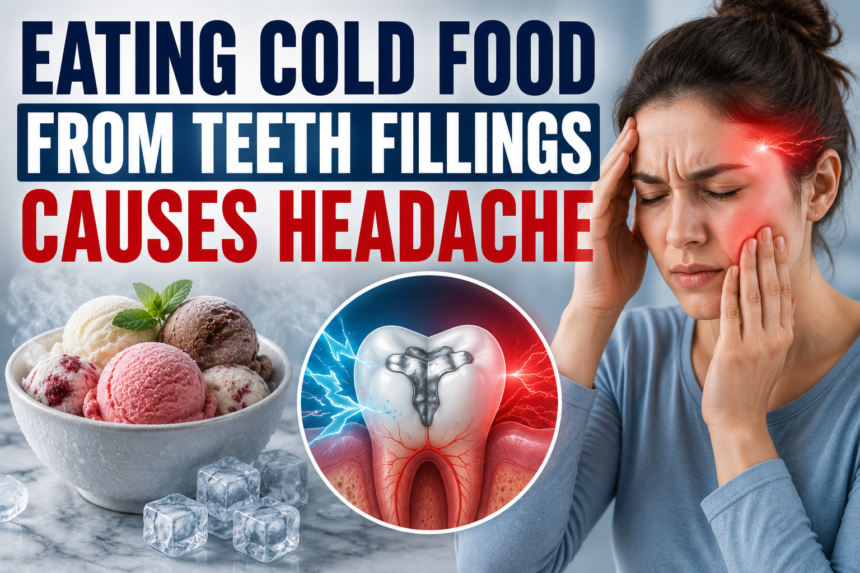
Eating cold food from teeth fillings causes headache in thousands of people every day — yet most never understand why. You bite into ice cream, drink a cold beverage, or eat chilled fruit, and within seconds a sharp jolt shoots from your tooth straight into your jaw, temple, or forehead. That’s not a coincidence or bad luck.
The connection between your dental filling and that pounding headache is rooted in nerve anatomy, filling material chemistry, and bite mechanics. This article explains every cause clearly, tells you which situations are normal versus alarming, and gives you practical steps to find real relief.
What Actually Happens When Cold Food Hits a Filling
To understand why eating cold food from teeth fillings causes headache, you need to understand what a filling does to your tooth’s internal structure.
When a dentist removes decay and places a filling, the tooth’s natural insulating layers — enamel and dentin — are altered. The filling material now sits close to the tooth’s pulp, which contains blood vessels and nerve endings.
Cold temperature causes two immediate effects:
- It causes the filling material (especially metal) to contract slightly, creating microscopic pressure on surrounding tooth structure.
- It stimulates the exposed or sensitized dentin tubules, sending a sharp pain signal directly along the trigeminal nerve.
The trigeminal nerve is the largest cranial nerve in your face. It branches across your jaw, cheek, temple, and forehead. When your tooth nerve fires a strong enough pain signal, the trigeminal nerve carries that signal upward — and your brain interprets it as a headache.
This process is called referred pain, and it’s the same mechanism that causes jaw pain to feel like an earache, or a heart attack to feel like left arm pain.
The 6 Most Common Reasons a Filling Causes Cold-Triggered Headaches
Not all filling sensitivity is the same. Understanding the specific cause helps you get the right fix faster.
1. Post-Procedure Nerve Inflammation (Pulpitis)
After any drilling and filling procedure, the tooth’s pulp undergoes mild inflammation. This is called reversible pulpitis, and it is the most frequent cause of cold sensitivity in the days and weeks after treatment.
The inflamed pulp is hypersensitive to any temperature change. Cold food triggers an amplified pain signal that travels straight up the trigeminal nerve pathway into your head.
2. A High Bite — The Most Overlooked Culprit
When a filling is placed even 0.1–0.2 mm too high, your opposing teeth strike it with excessive force every time you chew. You may not notice it at first, but over hours and days, this micro-trauma accumulates.
The result: jaw muscle tension, temporomandibular joint (TMJ) strain, and a tension headache that worsens when you eat — especially cold, hard foods that require more biting force.
3. Metal (Amalgam) Fillings Conduct Cold More Aggressively
Amalgam fillings are made from a mixture of silver, mercury, tin, and copper. Metal is an excellent thermal conductor — it transfers temperature changes to the underlying dentin far faster than tooth enamel does naturally.
When cold food touches an amalgam filling, the temperature drop travels to the pulp almost instantly. For patients with thin remaining dentin between the filling and the nerve, this creates an intense, shooting pain that radiates upward.
4. Cracked Tooth Syndrome Under or Around the Filling
Sometimes a crack develops in the tooth either before or during the filling procedure. Cold food causes the crack to flex, pinching the nerve inside.
This type of pain is characteristically sharp, brief, and directional — it happens when you bite in a specific spot. If left untreated, a cracked tooth can progress to an abscess or require extraction.
5. Exposed Dentin Around the Filling Margin
Over time, the seal between a filling and the natural tooth can develop microscopic gaps — a process called microleakage. Cold liquids and foods can seep through these gaps and directly stimulate the dentin tubules underneath.
Dentin contains thousands of tiny channels (tubules) that connect the outer tooth surface to the nerve. When cold fluid enters these tubules, it creates fluid movement that the nerve interprets as pain — a mechanism explained by the hydrodynamic theory of dentin sensitivity.
How Long Does Cold Sensitivity After a Filling Last?
Duration of sensitivity is one of the most important factors in determining whether your situation is normal or requires attention.
| Timeframe | What It Likely Means | Action Required |
| 0–2 weeks | Normal post-procedure inflammation | Monitor; use desensitizing toothpaste |
| 2–4 weeks | Pulpitis still resolving | Continue monitoring; avoid cold triggers |
| 4–8 weeks | Borderline — may need evaluation | Schedule a dentist check-up |
| 8+ weeks | Abnormal; possible irreversible pulpitis or cracked tooth | See dentist promptly |
| Worsening pain | Possible abscess or nerve damage | Urgent dental visit |
According to the American Dental Association (ADA), mild sensitivity after a filling procedure is normal and expected. Sensitivity that worsens or does not improve after 2–4 weeks should be evaluated by a dentist.
Dentin Hypersensitivity: The Science Behind the Pain
Dentin hypersensitivity affects a significant portion of dental patients. Research published in the Journal of Clinical Dentistry estimates that dentin hypersensitivity affects approximately 1 in 8 adults at any given time, with post-restoration sensitivity being among the most frequently reported triggers. (Source: Journal of Clinical Dentistry, 2013 Dentin Hypersensitivity Consensus Report)
The mechanism is well-established:
- Cold stimulus reaches exposed or sensitized dentin.
- Fluid movement inside the dentinal tubules is triggered.
- The movement activates nerve fibers (A-delta fibers) at the pulp-dentin junction.
- These fibers fire a pain signal along the trigeminal nerve pathway.
- The brain receives the signal and interprets localized or referred pain — including headache, jaw ache, or temple pressure.
Understanding this pathway explains why ibuprofen or acetaminophen (which reduce nerve inflammation systemically) can provide temporary headache relief — they’re dampening the same nerve pathway that’s causing both the tooth pain and the headache simultaneously.
Treatment Options: From Home Remedies to Dental Procedures
Home Remedies That Actually Help
- Desensitizing toothpaste (containing potassium nitrate or stannous fluoride) — Apply directly to the sensitive tooth twice daily. Brands like Sensodyne Repair & Protect or Colgate Sensitive Pro-Relief are widely used clinical options.
- Avoid temperature extremes — Allow cold foods to warm slightly in your mouth before chewing on the filled tooth.
- Ibuprofen (400 mg) — Reduces inflammation in the pulp and the trigeminal nerve pathway, providing dual relief for tooth pain and related headache.
- Warm saltwater rinse — Reduces gum inflammation around the filling margin.
When Your Dentist Can Help
- Bite adjustment (occlusal equilibration): A painless, quick procedure that reshapes the filling’s biting surface so teeth close evenly.
- Fluoride varnish or desensitizing agent: Applied directly to the tooth to block exposed dentin tubules.
- Filling replacement: If microleakage or a defective margin is found, replacing the filling resolves the sensitivity.
- Root canal treatment: Required only in cases of irreversible pulpitis where the nerve inside the tooth is permanently damaged. This is not the outcome for most cold-sensitivity cases.
- Crown placement: For cracked tooth syndrome, a dental crown stabilizes the tooth and prevents further crack propagation.
Cold Sensitivity After Filling: Amalgam vs. Composite — Which Is Worse?
| Feature | Amalgam (Metal) Filling | Composite (Resin) Filling |
| Thermal conductivity | High — cold transfers quickly | Low — more natural insulation |
| Cold sensitivity intensity | Typically more intense | Typically milder |
| Durability | 10–15+ years | 7–10 years |
| Bonding to tooth | Mechanical (no bonding agent) | Chemical bond to dentin |
| Post-procedure sensitivity duration | Can last 4–8 weeks | Usually resolves within 2–4 weeks |
| Recommended for | Large, back teeth restorations | Visible teeth, patients with metal sensitivity |
The ADA and the FDA both consider amalgam fillings safe for most patients, though composite options are increasingly preferred due to aesthetics and lower thermal sensitivity.
How to Prevent Filling-Related Headaches Going Forward
Prevention is always more effective than treatment. Follow these steps after any dental filling procedure:
- Ask your dentist to check your bite before leaving the chair — bite down on articulating paper and request any high spots be adjusted immediately.
- Use desensitizing toothpaste for 4 weeks post-procedure as a precaution, even if sensitivity hasn’t started yet.
- Avoid very cold foods for 72 hours after a filling is placed to allow the pulp to recover from drilling vibration.
- Choose composite over amalgam if you have a history of post-filling sensitivity — discuss this preference with your dentist before treatment begins.
- Schedule a 4-week follow-up — most dental practices don’t offer routine post-filling checks, but you can request one.
FAQ
Why does eating cold food from tooth fillings cause a headache?
Cold food stimulates sensitized nerve endings in or around the filling. The pain travels along the trigeminal nerve — which branches across your jaw, temples, and forehead — and your brain registers it as a headache. This is called referred pain and is a well-documented neurological phenomenon in dentistry.
How long does tooth sensitivity last after a filling?
For most patients, sensitivity after a filling resolves within 2–4 weeks. Composite fillings tend to settle faster than amalgam. If sensitivity persists beyond 6–8 weeks or is worsening, a dental evaluation is recommended. According to the ADA, prolonged sensitivity can indicate a bite issue or pulp involvement.
Is cold sensitivity after a filling normal?
Yes — mild cold sensitivity immediately after a filling is completely normal. The drilling process causes temporary nerve inflammation (reversible pulpitis). What is not normal is sensitivity that is severe, worsening, or accompanied by spontaneous pain without any cold trigger.
Can a high bite from a filling cause headaches?
Absolutely. A filling placed even fractions of a millimeter too high forces your jaw to compensate with every bite. This creates muscular strain in the masseter and temporalis muscles, leading to tension headaches. A simple occlusal adjustment at your dentist’s office can resolve this quickly.
When should I call my dentist about filling pain?
Call your dentist if: pain lasts more than 30 seconds after removing the cold source; pain is spontaneous (occurs without eating or drinking); swelling or gum soreness develops near the filling; or sensitivity has not improved after 4–6 weeks of using desensitizing toothpaste.
Does cold food sensitivity mean my filling needs to be replaced?
Not necessarily. In most cases, the cause is temporary nerve inflammation or a minor bite issue — both correctable without replacing the filling. However, if there is microleakage, a cracked tooth, or a defective filling margin, replacement may be the most effective solution.
Conclusion
When eating cold food from teeth fillings causes headache, your body is communicating something specific — not something random. The cause is almost always one of six well-understood mechanisms: post-procedure nerve inflammation, a high bite, metal filling conductivity, a cracked tooth, microleakage, or galvanic shock.
The good news is that the majority of cases resolve with simple interventions — desensitizing toothpaste, a brief bite adjustment, or just time. The important step is recognizing when the situation has moved beyond normal healing.
If your cold sensitivity is worsening, lasting beyond 6 weeks, or triggering severe headaches — schedule a dental evaluation today. Early attention prevents a minor sensitivity issue from becoming a root canal conversation.
Related Posts
Behavioral Health Billing: Complete Guide to Process, Coding, Claims, and Compliance
Eyes in Concussion: Symptoms, Vision Problems, and Recovery
Is Bowel Leakage a Sign of Cancer? What You Need to Know
Does Cataract Cause Headaches? Causes, Symptoms, Treatment, and Prevention Guide