


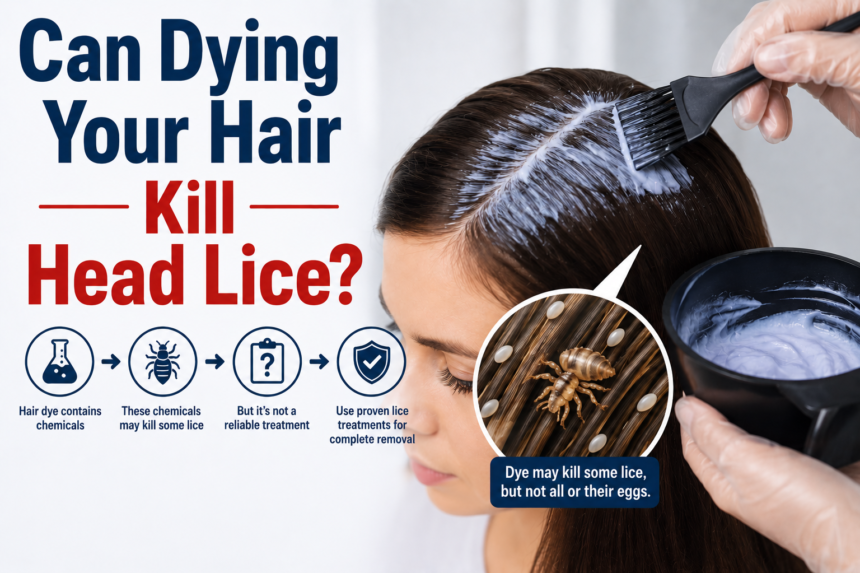
Can dying your hair kill head lice? This is one of the most common questions parents and adults ask when they discover a lice infestation — and it is completely understandable. Dealing with lice is stressful, embarrassing, and time-consuming, and the idea of a quick fix like a hair dye treatment sounds incredibly appealing.
The short answer is: hair dye may kill some adult lice, but it almost certainly will not eliminate nits (lice eggs) — meaning the infestation will return within days. In this article, you will learn exactly what the science says, which ingredients in hair dye affect lice, what actually works, and how to safely treat lice on chemically treated hair.
What Hair Dye Actually Does to Head Lice
Hair dye contains several chemicals that are potentially harmful to adult lice, but the story is more complicated than it seems. The two main active chemicals in permanent hair dye — ammonia and hydrogen peroxide — create an alkaline, oxidizing environment that can disrupt lice physiology.
How Ammonia and Hydrogen Peroxide Affect Lice
• Ammonia raises the hair shaft’s pH, which can penetrate a louse’s exoskeleton and potentially disrupt its nervous system.
• Hydrogen peroxide (developer) creates an oxidizing reaction that may damage the louse’s cellular structure.
• Together, these chemicals may kill or stun some adult lice on contact — but the effect is inconsistent and not clinically proven.
The critical problem is that these chemicals cannot penetrate the hard shell (chorion) of lice eggs (nits). Nits are attached to the hair shaft close to the scalp and are encased in a protective membrane that is highly resistant to chemical exposure.
Does Hair Dye Kill Lice and Nits? What the Research Shows
There is very limited formal research specifically on hair dye as a lice treatment. Most evidence is anecdotal, and the scientific consensus among dermatologists and pediatricians is clear: hair dye is not a recommended lice treatment.
The Centers for Disease Control and Prevention (CDC) does not list hair dye or bleach as an approved or effective lice treatment. According to the American Academy of Pediatrics (AAP), the only reliable treatments are FDA-approved pediculicides combined with manual nit removal.
Why Nits Are So Hard to Kill
• Nit shells are made of chitin — the same material in insect exoskeletons — making them highly resistant to most chemicals.
• Nits are cemented to hair shafts with a waterproof, glue-like substance produced by the female louse.
• The embryo inside the nit only becomes vulnerable during the final 24–48 hours before hatching.
• Even many FDA-approved treatments require a second application after 7–9 days to catch newly hatched nymphs.
Does Bleach Kill Head Lice? A Separate But Related Question
Bleaching hair — using a strong developer (often 30–40 volume) with bleach powder — is a more aggressive chemical process than standard hair dye. Some people assume that if regular dye does not fully work, bleach must be stronger and more effective. This logic is understandable but still flawed.
Bleach may kill more adult lice than standard dye due to the stronger concentration of hydrogen peroxide. However, it still fails to penetrate nit shells effectively. Additionally, bleaching carries significant risks:
• Severe scalp irritation, chemical burns, and skin sensitization — especially on an already irritated lice-infested scalp.
• Hair breakage and structural damage to chemically treated hair.
• The process typically lasts 30–45 minutes under a cap — not long enough for meaningful lice eradication.
Hair Color Treatment for Lice: Can You Use Both at Once?
Many people ask whether they can combine a hair color treatment with lice removal. The answer requires caution. Using hair dye and a lice treatment simultaneously is not recommended by dermatologists or pharmacists for several reasons.
Risks of Combining Hair Dye and Lice Treatments
1. Chemical interaction: Permethrin and pyrethrin-based shampoos can interact with the alkaline pH of hair dye, potentially reducing the effectiveness of both.
2. Scalp sensitivity: A lice-infested scalp often has micro-abrasions from scratching. Adding hair dye chemicals dramatically increases absorption risk and potential toxicity.
3. Residue interference: Hair dye can leave a coating on the hair shaft that prevents lice treatment ingredients from reaching lice near the scalp.
4. Timing conflicts: Most lice treatments need to sit for 10–20 minutes; dye requires 25–45 minutes. Combining them prolongs scalp chemical exposure unnecessarily.
Best Lice Treatment for Dyed Hair: What Actually Works
If you have chemically treated hair and need to deal with lice, you are not without options. The following treatments are clinically proven and safe for use on dyed or bleached hair, though you should always patch-test on irritated scalps and follow label directions carefully.
| Treatment Method | Kills Adult Lice? | Kills Nits (Eggs)? | Effectiveness | Safety |
| Permanent Hair Dye | Possibly (some) | No | Low | Scalp irritation risk |
| Bleach / Developer | Possibly (some) | No | Low | High irritation risk |
| Permethrin 1% (OTC) | Yes | Partial | High | Safe when used correctly |
| Malathion 0.5% (Rx) | Yes | Yes (partially) | Very High | Prescription needed |
| Benzyl Alcohol (Rx) | Yes | No | High | Rx, safe for ages 6 mo+ |
| Wet Combing (Nit Comb) | Yes (manual) | Yes (manual) | High (with repeat) | 100% safe |
| Dimethicone Oil | Yes | Partial | Moderate–High | Very safe, non-toxic |
Top 5 Proven Lice Treatment Products
These are real, commercially available, and clinically supported lice treatments. Pricing reflects typical U.S. retail or pharmacy costs as of mid-2025.
Nix Crème Rinse (Permethrin 1%)
• Best for: First-line treatment for typical lice infestations
• Pricing: ~$15–$20 at major pharmacies (OTC)
• Pros: Residual protection up to 10 days; widely available; safe for ages 2+
• Cons: Resistance reported in many U.S. states; requires second application; may be less effective on freshly dyed hair
Rid Lice Killing Shampoo (Pyrethrin + Piperonyl Butoxide)
• Best for: Adults and children with standard lice; budget-conscious families
• Pricing: ~$12–$18 (OTC)
• Pros: Fast-acting dual formula; widely trusted brand; works in 10 minutes
• Cons: Not ovicidal (does not kill eggs); requires repeat treatment; not for use on infants under 2 years
Sklice (Ivermectin 0.5% Lotion) — Prescription
• Best for: Treatment-resistant lice; single-application convenience
• Pricing: Rx required; ~$350 without insurance (check GoodRx for discounts)
• Pros: Single application, no nit combing required; highly effective against resistant lice
• Cons: Prescription required; expensive without insurance; not for children under 6 months
Ulesfia (Benzyl Alcohol 5% Lotion) — Prescription
• Best for: Cases of permethrin-resistant lice; sensitive scalps
• Pricing: Rx; ~$250–$300 without insurance
• Pros: Non-neurotoxic (suffocation mechanism); safe for ages 6 months+; gentler on scalp
• Cons: Requires two applications; prescription only
Natroba (Spinosad 0.9%) — Prescription
• Best for: Severe or resistant infestations where nit combing is difficult
• Pricing: Rx; costs vary (check with insurer)
• Pros: No nit combing required after treatment; effective in one application for most patients
• Cons: Prescription only; expensive; not recommended for neonates
How to Choose the Right Lice Treatment for Your Hair Type?
Selecting the right lice treatment depends on several personal factors — including whether your hair is chemically processed, your child’s age, and whether this is a first or repeat infestation.
• First infestation, unprocessed hair: Start with OTC permethrin (Nix) or pyrethrin (Rid) — these are effective and affordable.
• Dyed, bleached, or relaxed hair: Choose dimethicone (LiceMD) or benzyl alcohol (Ulesfia, Rx) to minimize scalp irritation from chemical overlap.
• Resistant or recurring infestations: See a physician for prescription-strength options like spinosad (Natroba) or ivermectin (Sklice).
• Pregnant or nursing: Consult a physician before using any lice treatment; pyrethrin and permethrin are generally considered low-risk, but professional guidance is essential.
• Infants under 2 years: Only use treatments specifically approved for their age group; consult a pediatrician.
Frequently Asked Questions (FAQ)
Does hair dye kill lice eggs (nits)?
No. Hair dye chemicals like ammonia and hydrogen peroxide cannot penetrate the hard protective shell (chorion) of lice eggs. Even if hair dye kills some adult lice, the nits will hatch within 7–10 days and restart the infestation. You must use a combination of an approved lice treatment and manual nit combing to eliminate nits.
Does bleaching your hair get rid of head lice?
Bleach is stronger than standard hair dye but still fails to kill nits reliably. It may kill or stun some adult lice due to higher hydrogen peroxide concentration, but no clinical evidence supports bleaching as a standalone lice treatment. Bleach also carries high scalp irritation and chemical burn risks, especially on an already-irritated, lice-infested scalp.
Can lice survive on dyed or chemically treated hair?
Yes. Lice do not discriminate based on hair color, hair type, or chemical treatment history. They feed on blood from the scalp — not the hair itself. Dyed, bleached, relaxed, or permed hair provides just as hospitable a habitat for lice as untreated hair.
What kills head lice instantly?
No treatment kills head lice completely in a single instant application. Prescription treatments like ivermectin (Sklice) are highly effective in a single application, but they still require time to work (the lotion must sit for 10 minutes). Wet combing removes lice mechanically. Dimethicone-based products suffocate lice over several minutes of contact.
How do you get rid of head lice permanently?
Permanent elimination requires a two-pronged approach: chemical treatment (to kill live lice) plus thorough manual nit removal (combing). A second treatment 7–9 days after the first catches any newly hatched nymphs. All household contacts should be checked, and bedding, hats, and hair accessories must be laundered in hot water and high-heat dried.
Does Vaseline (petroleum jelly) kill head lice?
Vaseline may suffocate adult lice when applied thickly to the scalp and left overnight under a shower cap, but it does not kill nits. It is also extremely difficult to wash out of hair, often requiring multiple shampoo sessions. Most dermatologists do not recommend it as a primary treatment due to its messiness and limited effectiveness on eggs.
Conclusion
Can dying your hair kill head lice? The answer is a clear no — at least not reliably, and certainly not the eggs. Hair dye and bleach may affect some adult lice, but they are no match for the resilient nits that will hatch and restart your infestation within a week.
Your fastest path to a lice-free scalp is a clinically proven treatment — whether OTC like Nix or LiceMD, or prescription-strength like Sklice or Natroba — combined with diligent nit combing over two to three weeks. If your hair is chemically processed, choose a gentler product and treat the lice before your next hair coloring appointment.
Related posts
Headache After Wisdom Teeth Removal: Causes, Relief, Recovery, and When to Worry
Dermatologist on Acne Scars: Causes, Types, and Proven Treatment Options
Cramps But No Period: Causes, Pregnancy Signs & When to Worry
Contributory Health Service Scheme: Benefits, Eligibility, Registration and Healthcare Coverage
How Long Does Cataract Surgery Take? Complete Timeline & Recovery Guide


