


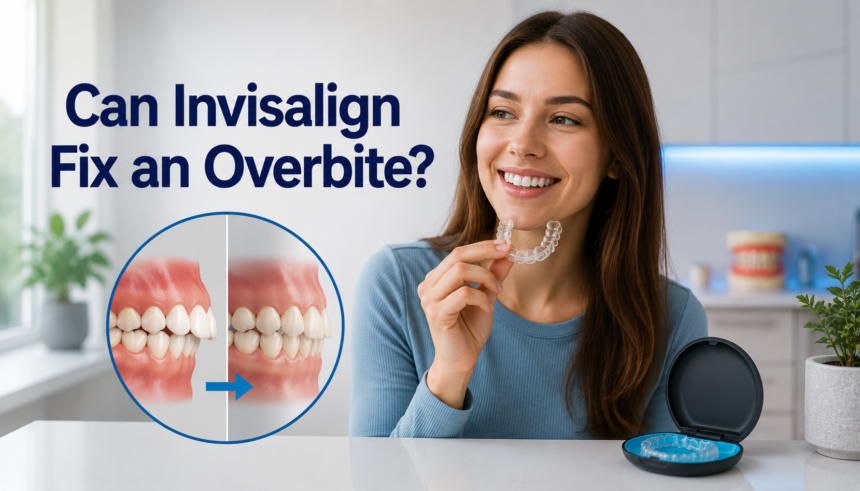
An overbite happens when the upper front teeth extend noticeably over the lower front teeth when the jaw is closed. Many people wonder, can Invisalign fix overbite problems without the need for metal braces, and the answer depends on how severe the bite misalignment actually is.
Invisalign uses a series of clear, custom-made aligners that gradually shift teeth into a healthier position, and for many dental type overbites, this system can produce real, lasting correction. However, not every case responds the same way, since skeletal or jaw-related overbites often need more than aligners alone.
This guide walks through how Invisalign works for overbite correction, what results to expect, how long treatment usually takes, and when a different approach may be necessary. By the end, you will have a clear picture of whether Invisalign is the right choice for your bite.
What Is an Overbite?
An overbite refers to the vertical overlap between the upper and lower front teeth, and it can range from mild to severe depending on the cause. Before deciding whether Invisalign can fix overbite issues in a specific case, it helps to understand the different types and degrees involved.
Types of Overbite (Dental vs Skeletal)
A dental overbite occurs when the teeth themselves are misaligned while the jawbone structure remains relatively normal, and this type usually responds well to aligner-based treatment. A skeletal overbite, on the other hand, involves an actual difference in the size or position of the upper and lower jawbones, which teeth-moving devices alone cannot fully correct. Identifying which type is present is usually done through a clinical exam combined with X-rays or a 3D scan.
Normal vs Excessive Overbite (Percentage Guide)
A small amount of overlap, typically around 10 to 20 percent, is considered normal and does not usually require treatment. When the overlap exceeds this range, the bite is classified as an excessive or deep overbite, and it may start to cause wear on the teeth or jaw discomfort over time. Orthodontists measure this percentage during an exam to decide how aggressive the treatment plan needs to be.
Can Invisalign Really Fix an Overbite?
This is the central question most people are searching for, and the short answer is yes, Invisalign can fix overbite cases that fall in the mild to moderate range. The sections below break down how the aligners actually move teeth and where the treatment reaches its limits.
How Invisalign Aligners Move Teeth
Each aligner in the series applies gentle, controlled pressure to specific teeth, nudging them a fraction of a millimeter at a time. Over several weeks, this gradual pressure repositions the upper and lower teeth so they meet more evenly when the jaw closes. Attachments, which are small tooth-colored bumps bonded to certain teeth, help the aligners grip and apply more precise force where it is needed most.
Mild to Moderate Overbite Correction
For overbites caused mainly by tooth position rather than jaw size, Invisalign can shift the upper front teeth back and the lower teeth forward until the bite lines up correctly. Most patients in this category see noticeable improvement within several months, with full correction often completed within a year. This makes Invisalign a strong option for dental overbites that are not tied to a skeletal issue.
Severe Overbite Limitations
When the overbite stems from a genuine mismatch in jaw size or position, clear aligners cannot move bone, so the underlying cause remains untouched. In these situations, Invisalign may improve the appearance of the bite slightly but will not resolve the root skeletal problem. Patients with severe Malocclusion are usually referred for combination treatment or a surgical evaluation instead of aligners alone.
Invisalign vs Braces for Overbite
Choosing between Invisalign and traditional braces for overbite correction often comes down to the severity of the case, along with personal preferences around comfort, appearance, and treatment speed.
Both systems can move teeth effectively, but they differ in how much control they offer over complex bite issues. The comparison below outlines the main differences to help clarify which option fits a particular situation.
| Factor | Invisalign | Traditional Braces |
| Best for | Mild to moderate overbite | Mild to severe overbite |
| Treatment time | 12 to 18 months on average | 18 to 24 months on average |
| Comfort | Smooth plastic, fewer sore spots | Metal brackets can irritate cheeks |
| Visibility | Nearly invisible | Clearly visible |
| Maintenance | Removable, easy to clean | Fixed, requires special brushes and floss |
| Precision for severe cases | Limited | Higher, especially with added appliances |
Neither option is universally better, since the right choice depends entirely on how the overbite is diagnosed and how the teeth and jaw respond during a consultation.
Signs Invisalign Can Correct Your Overbite
Certain clues can suggest that a case of overbite is likely to respond well to Invisalign rather than requiring surgery or heavier appliances. Recognizing these signs ahead of a consultation can help set realistic expectations.
• The overbite is caused mainly by tooth positioning rather than a difference in jaw size
• The degree of overlap falls in the mild to moderate range rather than the severe category
• There is little to no facial asymmetry linked to jaw structure
• The bite issue developed gradually rather than showing a clear skeletal pattern since childhood
• An orthodontist confirms during the evaluation that the case is aligner-appropriate
When most of these signs apply, Invisalign is often recommended as the first line of treatment.
How Long Does It Take to Fix an Overbite with Invisalign?
Treatment timelines vary based on how severe the overbite is at the start of care. Mild cases can sometimes show visible improvement in as little as six months, while moderate cases typically take between twelve and eighteen months to reach full correction.
Consistent wear of at least twenty to twenty two hours a day plays a major role in keeping the treatment on schedule, and skipping aligner time can extend the process considerably. Regular check-ins with the orthodontist allow the treatment plan to be adjusted if the bite is not shifting as expected.
Invisalign Attachments and Precision Bite Ramps for Overbite
For overbite cases specifically, orthodontists often add small attachments and precision bite ramps to the aligners to improve control over vertical tooth movement.
Bite ramps are raised sections placed on the back of the upper front aligners that gently push the lower teeth down and back into a corrected position each time the jaw closes.
These additions are especially useful because a standard aligner alone often lacks the leverage needed to correct significant vertical overlap on its own.
When Invisalign Alone Isn’t Enough
Some overbite cases go beyond what clear aligners are designed to handle, and recognizing this early helps avoid wasted time on a treatment that will not resolve the underlying issue. The two situations below are the most common reasons Invisalign is paired with or replaced by another approach.
Jaw Surgery Cases
When the overbite is caused by a significant skeletal discrepancy between the upper and lower jaw, orthodontic treatment alone cannot correct the bone positioning. Orthognathic, or corrective jaw surgery, is sometimes recommended alongside orthodontic treatment to reposition the jaw itself. This route is usually reserved for severe cases where the bite affects chewing, speech, or breathing.
Combination Treatment (Invisalign + Other Appliances)
In moderately complex cases, Invisalign may be combined with additional appliances such as elastics, expanders, or temporary anchorage devices to achieve a more precise result. These tools work alongside the aligners to apply extra force in directions that plastic trays cannot manage on their own. Combination treatment allows some patients to avoid surgery while still achieving meaningful bite correction.
Cost of Invisalign for Overbite Treatment
The cost of using Invisalign to correct an overbite depends on the complexity of the case, the length of treatment, and the region where care is provided.
Straightforward mild cases tend to sit at the lower end of the typical Invisalign price range, while moderate cases involving attachments, bite ramps, or a longer aligner series cost more.
Many orthodontic offices offer payment plans, and some dental insurance policies partially cover orthodontic treatment, so it is worth confirming coverage details before starting care.
How to Know If You’re a Candidate?
Determining candidacy starts with a professional evaluation rather than guesswork, since bite issues can look similar on the surface but have very different underlying causes. The following steps are typically part of that process.
• Schedule a consultation with an orthodontist experienced in Invisalign treatment
• Get digital scans or X-rays to determine whether the overbite is dental or skeletal
• Discuss the measured percentage of overlap and how it compares to a normal bite
• Review a proposed treatment plan, including whether attachments or bite ramps will be used
• Ask about expected timeline and cost based on the specific case
This process gives a clear, individualized answer rather than a general assumption about whether aligners will work.
FAQs
Can Invisalign fix a deep overbite completely? Invisalign can often improve a deep overbite that is dental in nature, but severe skeletal deep overbites may still need surgery or combination treatment for full correction.
Is Invisalign painful for overbite correction? Most patients feel mild pressure for a few days after switching to a new aligner, but it is generally less irritating than traditional braces.
How many aligners are needed to fix an overbite? The number varies by case, but moderate overbite corrections often require a series of twenty to forty aligners worn in sequence.
Can adults get Invisalign for an overbite? Yes, Invisalign is commonly used for adults, and age does not prevent treatment as long as the teeth and gums are healthy enough to move.
Conclusion
So, can Invisalign fix overbite problems? For mild to moderate cases caused by tooth position, the answer is generally yes, especially with the help of attachments and bite ramps. Severe skeletal overbites, however, usually require a more advanced approach involving combination treatment or jaw surgery. A consultation with an orthodontist remains the most reliable way to determine which path fits a specific bite.
RELATED POSTS
How Do You Get a Crick Out of Your Neck? Fast Relief Guide
Herbst Appliance: What It Is, How It Works & What to Expect
Dermatologist on Acne Scars: Causes, Types, and Proven Treatment Options


