


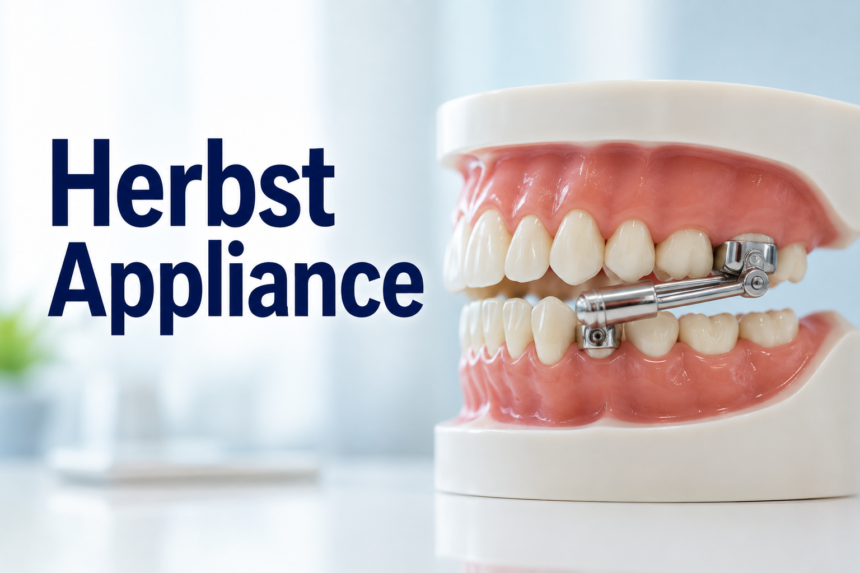
A Herbst appliance is a fixed orthodontic device that orthodontists use to correct a specific type of bite problem called Class II malocclusion, where the upper jaw sits noticeably ahead of the lower jaw.
Unlike removable devices, the Herbst appliance stays attached to the teeth around the clock, which means it works continuously without depending on a child’s cooperation to wear it. It is most commonly recommended for children and teenagers who are still growing, since the device relies on the body’s natural jaw growth to reposition the lower jaw forward over time.
Many parents first hear about this appliance during a routine orthodontic consultation when their child’s dentist notices a significant overbite. Understanding how the Herbst appliance works, who it is designed for, and what the treatment journey looks like can help families feel more prepared and confident going into treatment.
Key Takeaways
- A Herbst appliance is a fixed device used to correct Class II malocclusion by guiding the lower jaw forward.
- It is most effective in growing children and teens, typically between ages 8 and 14.
- Treatment usually lasts between 6 and 12 months, followed by traditional braces.
- The appliance uses metal rods or telescoping arms attached to bands or crowns on the molars.
- Mild discomfort, speech changes, and increased saliva are common in the first few weeks.
- Costs generally range between $2,000 and $4,000 depending on location and provider.
What Is a Herbst Appliance?
A Herbst appliance is a type of fixed functional orthodontic device that corrects overbite by holding the lower jaw in a forward position relative to the upper jaw. It is bonded or banded directly onto the back molars, so the patient cannot remove it, which allows for consistent and predictable correction throughout treatment. Below, we look at how it is defined in more detail and how it compares to other orthodontic tools.
Definition and Purpose
The Herbst appliance was developed to treat cases where the lower jaw is set back relative to the upper jaw, a condition often described as an overbite or retrognathic mandible. Its main purpose is to encourage the lower jaw to grow forward while simultaneously restricting some forward growth of the upper jaw. This dual action helps bring the bite into better alignment before braces are used to fine-tune individual tooth positions.
How It Differs From Other Orthodontic Devices
Unlike headgear, which patients wear only part of the day, the Herbst appliance is fixed in the mouth and functions continuously without requiring daily compliance. It also differs from simple braces because braces move individual teeth, while the Herbst appliance works on the position of the entire jaw. This makes it a functional appliance rather than a purely cosmetic or alignment tool.
How Does a Herbst Appliance Work?
The Herbst appliance works by using metal arms or rods connected between the upper and lower molars, which physically prevent the lower jaw from sliding backward. Every time the patient bites down, chews, or speaks, the appliance guides the jaw into a more forward position. Over months of continuous use, this repeated forward positioning encourages new bone growth in the jaw joint area.
Mechanism of Jaw Repositioning
The appliance works through a hinge-like mechanism that connects the upper and lower dental arches. When the patient tries to close their mouth into a normal backward bite, the telescoping rod prevents this movement and forces the jaw to stay forward. This constant forward stimulation is what triggers the mandible’s condylar growth centers to develop additional bone, gradually creating a more balanced jaw relationship over time.
Components (Bands, Crowns, Telescoping Arms)
The Herbst appliance typically consists of stainless steel bands or crowns cemented onto the upper and lower first molars, along with a pair of telescoping rod-and-tube assemblies connecting them on each side of the mouth. Some modern versions use a bonded design instead of bands, which covers less visible tooth surface. The telescoping arms allow some side-to-side and vertical jaw movement while still restricting the backward slide that causes the original bite problem.
Who Needs a Herbst Appliance?
A Herbst appliance is generally recommended for growing patients with a diagnosed Class II bite relationship, where the upper teeth or jaw protrude noticeably in front of the lower teeth or jaw. Orthodontists assess growth potential using dental records, X-rays, and physical examination before recommending this treatment path.
Class II Malocclusion Explained
Class II malocclusion is a classification used in orthodontics to describe a bite in which the upper first molar sits significantly ahead of the lower first molar, often resulting in a visible overbite or an overjet where the upper front teeth protrude. This condition can affect chewing, speech, facial appearance, and in some cases, breathing patterns during sleep. It is one of the most common reasons children are referred for early orthodontic evaluation.
Ideal Age Range for Treatment
The Herbst appliance is most effective when used during a child’s active growth phase, generally between the ages of 8 and 14, though the exact window varies by individual growth patterns. Treating the bite during this period takes advantage of the jaw’s natural growth potential, which becomes far more limited once skeletal growth slows down after puberty. Orthodontists often use hand-wrist X-rays or growth charts to help time treatment appropriately.
Types of Herbst Appliances
There are a few different design variations of the Herbst appliance, and orthodontists choose between them based on the patient’s specific dental anatomy and treatment goals. The main differences involve how the device attaches to the teeth and whether it can be removed.
Banded vs. Bonded Herbst
The banded version uses metal rings cemented around the molars, offering strong retention for patients with more active bite forces or a history of loosening appliances. The bonded version instead uses acrylic or composite material attached directly to the tooth surface, which some orthodontists prefer for its lower profile and reduced visibility. Both versions achieve the same jaw-repositioning function, though banded designs tend to be more durable for longer treatment periods.
Removable vs. Fixed Variants
While the traditional Herbst appliance is fixed and cannot be taken out by the patient, some orthodontists offer a removable version that functions similarly but relies on patient compliance to wear it consistently. Fixed variants are generally more predictable in outcome since there is no risk of a child forgetting to wear the device. Removable versions may be considered for older, more compliant patients who prefer more control over the appliance.
The Herbst Appliance Treatment Process
Treatment begins with a diagnostic evaluation, moves through the fitting and adjustment phase, and continues for several months until the desired jaw relationship is achieved. Patients typically visit the orthodontist periodically throughout treatment for progress checks and minor adjustments.
Initial Consultation and Fitting
During the first visit, the orthodontist takes dental impressions, X-rays, and photographs to plan the exact appliance dimensions needed for the patient’s mouth. The fitting appointment itself usually takes about one to two hours, during which the bands or crowns are cemented into place and the telescoping arms are attached and adjusted for proper length.
Adjustment Period
The first one to two weeks after placement are typically the most uncomfortable, as the mouth adjusts to the new forward jaw position and the presence of metal components. Patients often notice increased saliva production, minor speech changes, and some difficulty chewing, all of which tend to improve significantly as the mouth adapts.
Duration of Treatment (6–12 months)
Most patients wear the Herbst appliance for approximately six to twelve months, depending on the severity of the initial bite discrepancy and how the individual responds to treatment. After the jaw relationship has improved, the orthodontist removes the appliance and typically transitions the patient into traditional braces to align individual teeth.
Benefits of the Herbst Appliance
The Herbst appliance offers several advantages over other methods of correcting an overbite, particularly for growing patients who want to avoid more invasive treatment later in life.
Corrects Overbite Without Surgery
By taking advantage of a child’s natural growth potential, the Herbst appliance can correct significant jaw discrepancies without the need for jaw surgery, which is sometimes required in adults with severe, fully developed Class II bites. This makes early treatment particularly valuable for patients diagnosed while still growing.
Faster Results Compared to Headgear
Because the Herbst appliance works continuously rather than only during the hours it is worn, many patients see noticeable bite improvement faster than they would with removable headgear. This continuous action also removes the variable of patient compliance, which is often a limiting factor with removable devices.
Potential Side Effects and Discomfort
Like most fixed orthodontic appliances, the Herbst device can cause some temporary discomfort and lifestyle adjustments, especially in the early weeks of treatment.
Common Issues (Soreness, Speech Changes)
Patients commonly report jaw soreness, cheek irritation from the metal components, and temporary changes in speech clarity immediately after placement. Some children also experience mild difficulty opening their mouth fully during the first few days as the muscles adapt to the new bite position.
How to Manage Discomfort
Orthodontists often recommend soft foods, over-the-counter pain relief as needed, and orthodontic wax to reduce irritation from the metal bands or arms rubbing against the cheeks. Most discomfort resolves within one to two weeks as the mouth becomes accustomed to the appliance.
Herbst Appliance vs. Other Class II Correctors
Several appliances are used to treat Class II malocclusion, and each has distinct advantages depending on the patient’s needs and the orthodontist’s preferred approach.
| Appliance | Type | Wear Requirement | Typical Duration |
| Herbst Appliance | Fixed | Continuous, non-removable | 6–12 months |
| Twin Block | Removable | Patient-dependent | 9–12 months |
| Headgear | Removable | 12–14 hours/day recommended | 12–18 months |
| MARA Appliance | Fixed | Continuous, non-removable | 6–12 months |
Herbst vs. Twin Block
The Twin Block is a removable two-piece appliance that also repositions the jaw forward, but its success depends heavily on how consistently the patient wears it each day. The Herbst appliance removes this variable entirely since it cannot be taken out, generally leading to more predictable outcomes in less cooperative patients.
Herbst vs. Headgear
Headgear relies on an external strap-based system worn mostly during sleep or at home, which limits its effectiveness if the patient does not follow the recommended wear schedule. The Herbst appliance’s fixed nature means it works around the clock, often producing comparable or faster results without relying on daily compliance.
Herbst vs. MARA Appliance
The MARA appliance is another fixed functional device similar in purpose to the Herbst but uses a different mechanical design involving elastics and metal arms attached to crowns. Both appliances achieve similar jaw correction goals, and the choice between them often comes down to the orthodontist’s training and the patient’s specific dental anatomy.
Caring for a Herbst Appliance
Proper care during treatment helps prevent complications like tooth decay, gum irritation, or damage to the appliance itself.
Oral Hygiene Tips
Patients should brush thoroughly around the bands, crowns, and rods after every meal, since food particles can easily become trapped in the appliance’s metal components. Using a water flosser or interdental brush can help reach areas that a standard toothbrush may miss, reducing the risk of cavities or gum inflammation during treatment.
Foods to Avoid
Hard, sticky, or chewy foods such as caramel, hard candy, and whole apples should be avoided, as they can bend the telescoping rods or dislodge the bands. Patients are generally advised to cut firmer foods into smaller pieces and avoid biting directly into them with their front teeth.
Cost and Insurance Considerations
Understanding the financial side of treatment helps families plan ahead before committing to this type of orthodontic correction.
Average Price Range
The cost of a Herbst appliance typically ranges from about $2,000 to $4,000, depending on the orthodontist’s location, experience, and whether the appliance is banded or bonded. This cost is often separate from the braces phase that usually follows once jaw correction is complete.
Insurance Coverage Factors
Many dental insurance plans that include orthodontic benefits will cover a portion of Herbst appliance treatment, particularly when it is documented as medically necessary rather than purely cosmetic. Coverage amounts vary widely, so families are generally advised to confirm specific benefit details with their insurance provider before starting treatment.
Life After the Herbst Appliance
Once the jaw relationship has been corrected, treatment does not typically end immediately, as most patients still need further orthodontic work to achieve a fully aligned smile.
Follow-Up Braces or Retainers
After the Herbst appliance is removed, most orthodontists place traditional braces to align individual teeth and fine-tune the bite now that the jaw relationship has improved. Retainers are usually required afterward to maintain both the corrected jaw position and the newly aligned teeth.
Long-Term Results
When treatment is completed during the appropriate growth window, the improvements to jaw alignment achieved with a Herbst appliance are generally stable long-term, especially when combined with consistent retainer wear. Most patients see lasting improvement in both bite function and facial profile as a result of early intervention.
Frequently Asked Questions
Is the Herbst appliance painful? Most patients experience mild to moderate soreness for the first one to two weeks, which typically improves as the mouth adjusts to the new bite position.
Can you eat normally with a Herbst appliance? Yes, though soft foods are recommended initially, and hard or sticky foods should be avoided throughout treatment to prevent damage to the appliance.
How long do you wear a Herbst appliance? Most patients wear the appliance for six to twelve months, followed by a period of traditional braces to complete the bite correction.
Does the Herbst appliance work on adults? It is far less effective in adults since it relies on active jaw growth, so it is primarily recommended for children and teenagers who are still growing.
Conclusion
The Herbst appliance remains one of the most reliable fixed options for correcting Class II malocclusion in growing children and teens.
By working continuously rather than depending on daily compliance, it often delivers faster and more predictable results than removable alternatives like headgear or the Twin Block.
Families considering this treatment should consult a qualified orthodontist to determine whether their child falls within the ideal growth window for the best possible outcome.
RELATED POSTS
Dental Bone Graft Specialist: Procedure, Recovery, & Risks Guide
Do Pimple Patches Work on Blackheads? Here’s the Truth
Does Mucinex Make You Cough More? What You Should Know
Bone Spur Inside Nose: Causes, Symptoms & Treatment
Best Footwear for Achilles Tendonitis: Podiatrist-Backed Picks for 2026


