


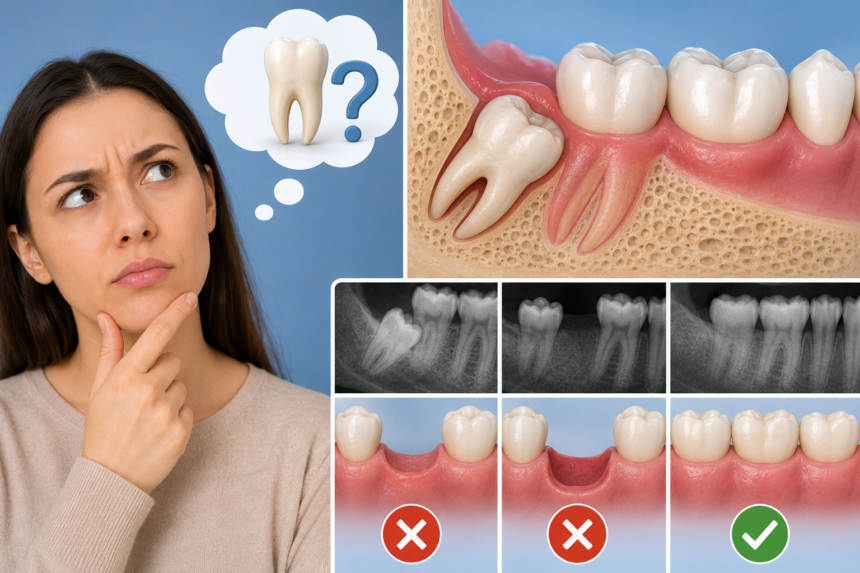
Can wisdom tooth regrow once it’s been pulled out? It’s a question a lot of people ask a few weeks after surgery, especially when something in the back of the mouth feels different or sore again. That worry is completely understandable, since a new bump or ache can genuinely feel like a tooth pushing through. This guide breaks down what’s actually happening in your mouth, why it can feel like regrowth, and exactly when that feeling is worth a dental visit.
Wisdom teeth removal is one of the most common oral surgeries performed on teens and young adults, so this question comes up constantly in dental offices. By the end of this article, you’ll know the real biology behind tooth development, the rare exception that confuses people, and the warning signs that mean you should call your dentist.
Key Takeaways
- A fully extracted wisdom tooth, root and all, cannot regenerate — humans only grow two sets of teeth in a lifetime.
- Lingering soreness or a hard bump at the extraction site is usually healing bone or scar tissue, not a new tooth.
- A rare condition called hyperdontia can cause extra “supernumerary” teeth to erupt later, but this is unrelated to true regrowth.
- Research cited by Healthline points to roughly a 2% chance of having supernumerary teeth, based on a 2015 study of more than 7,300 people.
- Persistent pain, swelling, or a visible new tooth-like structure should always be checked by a dentist with an X-ray.
What Happens to a Tooth During Extraction?
Understanding wisdom teeth removal helps explain why regrowth isn’t biologically possible. During a standard extraction, the oral surgeon removes the entire visible crown along with the roots below the gumline. Nothing is left behind to act as a seed for a new tooth.
This is different from how baby teeth work, and that distinction confuses a lot of patients.
- Baby teeth have roots that dissolve naturally to make space for permanent teeth underneath.
- Wisdom teeth (third molars) are already part of your permanent, adult set of teeth.
- Once a permanent tooth and its root are gone, the body has no mechanism to build a replacement in that spot.
Pro Tip: If your extraction site still feels sensitive months later, ask your dentist to check for a retained root tip. It’s not a new tooth, but a small leftover fragment can sometimes cause lingering discomfort.
Can Wisdom Tooth Regrow?
No — a fully extracted wisdom tooth cannot regrow. Once the tooth and its root structure are removed, that specific tooth is permanently gone. Multiple oral surgery practices confirm this consistently: after full extraction, the site heals with bone and gum tissue, not new dental structure.
That said, “no” isn’t the whole story, which is exactly why the question keeps coming up.
- Humans develop only two sets of teeth across a lifetime: primary (baby) teeth and permanent teeth.
- Wisdom teeth are the last permanent molars to erupt, typically between ages 17 and 25.
- There is no third “regeneration” set that follows permanent tooth loss.
- What people often mistake for regrowth is one of a few specific, explainable conditions covered next.
Why It Feels Like Your Wisdom Tooth Is Growing Back?
This is the part that actually matters for most readers, since the sensation is real even though a new tooth is not. Several distinct things can create that “it’s coming back” feeling.
Healing Bone and Gum Tissue
After extraction, your jawbone naturally remodels the empty socket. As bone and gum tissue fill in over several weeks, the area can feel firm, slightly raised, or tender — easy to mistake for a tooth pushing up.
Retained Root Fragments
In some extractions, a tiny piece of root is intentionally or unintentionally left behind if removing it fully would risk nerve damage. These fragments don’t grow into teeth, but they can shift slightly and cause discomfort.
Adjacent Teeth Shifting
Once a wisdom tooth is gone, nearby molars can gradually shift into the open space. That shifting pressure can feel like something new emerging, even though it’s really tooth movement, not tooth growth.
Warning: Sharp pain 3–5 days after surgery, especially with a foul taste or visible empty socket, can signal dry socket — a real complication that needs prompt dental care, not just time.
Supernumerary Teeth: The Real Exception
Secondary keyword focus: supernumerary teeth are the closest thing to a genuine exception to “wisdom teeth never come back,” and they’re the reason dental blogs can’t give a flat, unqualified no.
Supernumerary teeth are extra teeth beyond the standard adult set of 32. According to Healthline’s coverage of a 2015 study involving more than 7,300 patients, people have roughly a 2% chance of having supernumerary teeth. A separate dental practice review notes that some estimates for this genetic condition run closer to under 4% of the population, depending on the study population and imaging method used.
Key facts about supernumerary teeth:
- The condition is called hyperdontia, and it’s determined by genetics, not by having had a previous extraction.
- Extra teeth can appear anywhere in the mouth, not just near old wisdom tooth sites.
- They’re usually spotted on routine dental X-rays before they cause any symptoms.
- They can lead to crowding, misalignment, or aesthetic concerns if left unaddressed.
Hypothetical Example (for illustration purposes): A 24-year-old patient has all four wisdom teeth removed at age 19. Five years later, she notices a new hard bump near her lower right jaw and books an appointment, worried her wisdom tooth is “growing back.” An X-ray reveals a small supernumerary tooth that had been developing separately the entire time, unrelated to her earlier extraction. Her dentist monitors it and removes it once it becomes a crowding risk. Note: This scenario is illustrative. Actual results vary based on individual anatomy, genetics, and dental history.
What Dentists Actually Look For on X-Rays
When a patient reports a feeling of tooth regrowth, dentists don’t guess — they image the area. This section covers what that process involves so you know what to expect at your own appointment.
How to spot the difference at home before your appointment:
- Check the timeline. Symptoms appearing within the first 1–2 weeks after surgery are almost always part of normal healing.
- Look for a visible tooth shape. Genuine new eruption (supernumerary teeth) usually shows a distinct tooth-like point breaking the gum surface.
- Note the location. Pain in the exact extraction socket points toward healing tissue or a root fragment, not new growth.
- Track how long it lasts. Healing discomfort fades within weeks; a true supernumerary tooth stays firm and often grows slowly over months.
- Get an X-ray regardless. Only imaging can confirm what you’re feeling, so don’t rely on self-diagnosis alone.
Post-Extraction Sensations Compared
Because so many different things can mimic “regrowth,” a side-by-side comparison makes the differences much clearer than description alone.
| Sensation | Likely Cause | Typical Timeline | Needs a Dentist Visit? |
| Firm bump at socket | Healing bone/gum tissue | 2–8 weeks post-surgery | Only if painful or growing |
| Sharp, radiating pain | Dry socket | Day 3–5 post-surgery | Yes, promptly |
| Small hard fragment felt with tongue | Retained root tip | Weeks to months | Yes, for evaluation |
| New tooth-shaped bump elsewhere in jaw | Supernumerary tooth | Months to years later | Yes, for X-ray confirmation |
| Teeth feeling “loose” or shifted | Adjacent teeth moving into space | Months after healing | If bite feels affected |
Do Wisdom Teeth Serve Any Purpose?
It’s worth understanding why wisdom teeth cause so much trouble in the first place, since that context explains why dentists rarely worry about “losing” them for good.
Wisdom teeth, or third molars, likely helped early humans chew tougher, less-processed foods like roots and raw meat. As diets became softer and jaws evolved to be smaller over generations, most modern mouths no longer have room for a third set of molars. That’s a major reason they’re commonly impacted, angled, or partially erupted, and why extraction is so routine today.
- Most people have four wisdom teeth, though the number varies by individual.
- Some people are naturally missing one or more wisdom teeth — a trait linked to genetics.
- Impacted or partially erupted wisdom teeth raise the risk of infection, cysts, and crowding, which is why extraction is often recommended before problems start.
When to See a Dentist After Wisdom Tooth Removal
If you’re still wondering can wisdom tooth regrow weeks or months after your procedure, the safest move is always a professional check rather than guessing based on symptoms alone.
Book an appointment if you notice:
- Pain that increases instead of easing after the first week
- Swelling, redness, or discharge from the extraction site
- A visible new tooth-shaped structure breaking through the gum
- Numbness or tingling that doesn’t improve over time
- Difficulty opening your mouth or chewing normally weeks after healing should be complete
Reliable organizations like the American Dental Association publish general guidance on post-extraction care and warning signs, and it’s worth reviewing their patient resources alongside your dentist’s specific instructions.
Frequently Asked Questions
Q: Can a wisdom tooth grow back after it’s been pulled?
No, a fully extracted wisdom tooth cannot regrow. The entire tooth and root are removed during surgery, leaving nothing behind that could regenerate into a new tooth.
Q: Why does it feel like my wisdom tooth is growing back?
This feeling usually comes from healing bone and gum tissue filling the socket, a retained root fragment, or nearby teeth shifting into the open space — not an actual new tooth.
Q: What are supernumerary teeth?
Supernumerary teeth are extra teeth beyond the normal adult set of 32, caused by a genetic condition called hyperdontia. They can appear anywhere in the mouth, unrelated to prior extractions.
Q: How common is it to have extra wisdom teeth?
Research cited by Healthline puts the odds at roughly 2% of people, based on a 2015 study of over 7,300 patients, though some practices report slightly higher estimates near 4%.
Q: Can a leftover piece of tooth root regrow into a full tooth?
No. A retained root fragment can cause discomfort or minor irritation, but it does not have the structure needed to develop into a complete, functional tooth.
Q: How do I know if something is wrong after a wisdom tooth extraction?
Watch for worsening pain, swelling, fever, or a foul taste after day three, which can indicate dry socket or infection. These symptoms warrant a same-week dental visit.
Q: Do wisdom teeth serve any real purpose today?
Not much for most people. They likely helped ancient humans chew tougher foods, but modern jaws typically lack room for them, which is why impaction and removal are so common now.
Conclusion
A wisdom tooth cannot regrow once it’s fully extracted, but the sensations that make people ask the question — healing tissue, root fragments, or rare supernumerary teeth — are all real and worth understanding. Knowing the difference means you can tell normal healing from something that actually needs attention.
RELATED POSTS
How to Get Eyelash Out of Eye Safely: Easy Methods, Causes, and When to See a Doctor
Contributory Health Service Scheme: Benefits, Eligibility, Registration and Healthcare Coverage
Acnes Gentle Cleanser: Honest Review & Full Guide
How to Get Rid of a Headache Fast: Proven Relief Methods That Work


